Blog Titles
ToggleMagic and Witchcraft in Ephesus
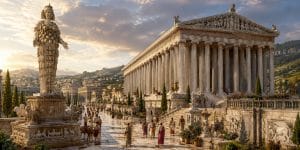
Ancient Ephesus is such a vast and profound city that its mystery and magic are endless. As one of the four largest cities in the world during both the Greek and Roman periods, Ephesus was a city full of action and spectacle. One of the most significant of these was magic and sorcery, symbols of power in the ancient world.

Magic in Ephesus
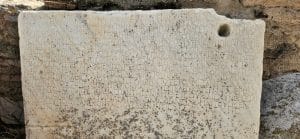
Curse tablets are indispensable elements of magic and sorcery. In the ancient world, we called them Katadesmos in Greek and Defixiones in Latin. These tablets, usually small and thin plates (leaves) with inscriptions on them, are used to address the gods, aiming to influence the behavior or well-being of people or animals against their will through supernatural means.
These types of katadesmos (curse plaques) were generally written for:
Legal and Commercial Cases
Love or Jealousy
To Prevent Rivals
To Make Someone Fall in Love with You.
More than 1600 plaques, mostly in Greek, have been found to date. Around 50 of these lead plates (leaves) have also been found in the ancient city of Ephesus. Considering that Ephesus has been excavated since 1890, and that the areas uncovered so far are mostly public buildings, with the actual living spaces yet to be excavated, there is no doubt that many more curse plaques will be found through further excavations.
Of the curse tablets found so far, 1100 belong to the Greek period and around 500 to the Roman period. In fact, all the curses of Attic origin related to legal cases that are abundantly available belong to the classical period (480 BC – 323 BC).
Love curses and justice curses aimed at separation date back to the 4th century BC. These curses were used in the Mediterranean and Aegean countries and colonies.
Examples of Catadesmos found in Ephesus:
On love and jealousy
Love Binding Curse
“I bind Heraclides;
I surrender his soul, mind, and body
to me.”
Examples for legal and commercial courts:
“I bind Dionysius’ tongue,
his speech, and his testimony.
May he be unable to speak in court,
may his words be powerless.”
Black Magic, the most dangerous type of magic.
Pars Pro Toto = This spell was based on the belief that its effect could only be achieved by touching the whole victim, not just a part of them. It was considered the most powerful spell in the ancient world.
If a part of the victim (item = ousia) was placed in the tomb along with the corpse, there was a hope that it could also cause a fatal or hindering action against the victim. This method was used especially in love spells, whether for sexual attraction or separation.
Lucian mentions a spell for sexual attraction that required a lock of hair, a piece of clothing, or a shoe from the lover.
Furthermore, stolen items were generally transferred to the ownership of God, thus transforming the crime of theft committed against a mortal into a sin against God.

Magic prices in ancient Ephesus
The fee for one spell is 2 drachmas and 1 obolos. 1 drachma is equal to 50-80 USD and 1 obolos is equal to 8-13 USD.
Besides this, the sorcerer was given bread and wine to eat and drink, as well as the necessary materials for the ritual: a torch, sulfur, salt, and one or two items belonging to the sacrifice.
The Ephesians, whom Saint Paul had converted to Christianity, also burned their books of magic, worth a total of 50,000 silver coins. 50,000 Ephesian silver cistophorus would be worth approximately $1,400,000 today. These “cistophorus” were silver coins weighing about 12–12.5 grams. In accounting, these cistophorus were equivalent to about 3 denarius / approximately 3 drachmas.
The “Acts of the Apostles in Ephesus” mentioned is most likely connected to the famous passage in the Book of Acts that describes the practices of witchcraft in Ephesus.
The Key Biblical Passage (Magic in Ephesus)
Acts 19:17–20
This is the most important section:
“Many of those who practiced magic brought their books together and burned them publicly…
“The value of them was fifty thousand pieces of silver.”
This refers to the famous Ephesia Grammata (Ephesian magical words/spells).

One of the most famous magicians who lived in Ephesus was Alexander of Abonoteichus.
Pliny the Elder likened the color of lead to the color of the dead.
“Just as these words are cold and written from right to left (Eparistera), so too should Krates’ words be cold and reversed.”
A curse inscription from the Attic Kerameikos area.

Ephesia Grammata
Ephesia Grammata, also known as “Ephesian Words,” are mysterious magical formulas used in ancient Greece, particularly in the city of Ephesus. These sequences of words were both religious and protective; they were used to ward off evil spirits, and to bring good luck and protection.
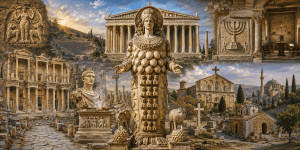
The statue of Artemis in Ephesus has the inscription “Ephesia Grammata” faintly visible on its feet, belt, and crown.
Plutarch, in his Quaestiones Convivales, reports that the Magi ordered those believed to be possessed by demons to read the Ephesian letters.
In the comedy Lyropoios, written by Anaxilas in the 4th century, one of the characters wears a belt inscribed with Ephesia Grammata.
The best-known Ephesian Grammata are a group of six words:
ΑΣΚΙ(ΟΝ) ΚΑΤΑΣΚΙ(ΟΝ) ΛΙΞ ΤΕΤΡΑΞ ΔΑΜΝΑΜΕΝΕΥΣ ΑΙΣΙΟΝ (or ΑΙΣΙΑ )
These words are the famous magic formula known in the ancient world as Ἐφέσια Γράμματα (Ephesia Grammata).
These words are particularly associated with the cult of the Temple of Artemis and originated in Ephesus.
These words are not normal Greek sentences. Most researchers consider them to be magic words (voces magicae).
Some interpretations:
ΑΣΚΙΟΝ: shadowless / mysterious power
ΚΑΤΑΣΚΙΟΝ: power under the shadow
ΛΙΞ: sacred sound / magic word
ΤΕΤΡΑΞ: four directions / four elements
ΔΑΜΝΑΜΕΝΕΥΣ: powerful one / dominant power
ΑΙΣΙΟΝ: good fortune / sacred thing
Askion = darkness / shadow
kataskion = deep shadow
Lix = unknown / sacred sound
Tetrax = “four” or cosmic order
Damnameneus = name of a divine power
Aisia = fate / destiny
Ancient writers also describe this formula. For example:
• Clement of Alexandria
• Plutarch
These words of magic appear in the writings of the Grammata of Ephesia.
These words were usually written on:
• Amulets
• Rings
• Magic tablets
• Necklaces.
People believed that this protected them from evil spirits.
On some ancient amulets, these words are written in reverse or arranged in a triangle shape. This was thought to make the magic more powerful. In some ancient magical inscriptions, these words are written together with star, spiral, and triangle symbols.
What was katadesmos and how was it performed?
Known as ancient magic, katadesmos (κατάδεσμος) was a very popular form of magic in Ephesus. Ephesians, or people living in Ephesus, would use a small piece of a person’s body to cast a spell on them.
For example:
• hair
• nails
• a piece of clothing
• a written name
• a small figurine
It was believed that this piece represented the whole person.
A sorcerer might do the following:
1. Write a curse tablet (katadesmos) out of lead.
2. Put the person’s hair inside.
3. Fold and nail the tablet.
4. Drop it into a grave or well.
Purpose:
To bind the person’s soul, mind, or actions.
How was the Katadesmos spell performed?
1. A thin lead plate was taken.
2. The Greek text was carved into it with a needle or nail.
3. The tablet was folded or pierced.
4. Then it was left in the following places:
• tombs
• wells
• temples
• sewers
In excavations in Ephesus, some katadesmos (curse tablets) have been found, especially in the Terrace Houses area. Some of these were discovered near toilets and sewers.
Why were curse tablets left in toilets?
In the ancient world, people viewed toilets and sewers as:
• gateways to the underworld
• passageways for evil spirits.
Therefore, curse tablets were left there. It was believed that this way the magic would reach the underworld gods. Also, baths were seen as places where spirits roamed during the Roman period. Because it was believed that these places were close to the underworld gods.
Types of Katadesmos (Katadesmoi)
1 – Love spell: To make someone fall in love.
2 – Court curse: To prevent an opponent from speaking in court.
3 – Commercial rivalry: To cause a rival merchant to fail.
4 – Sports curse: To cause a rival athlete or player to lose.

Magic Symbols Used in Ephesus
The magical inscriptions in Ephesus contained not only words but also strange symbols and signs:
• Star signs
• Triangles
• Cross-like symbols
• Spiral signs
• Mysterious letter combinations
These were believed to ward off evil spirits.
The ancient writer Plutarch recounts:
A wrestler has these words inscribed on his belt and becomes invincible in competitions. But when someone notices the spell and removes the belt, the wrestler immediately loses.
Where were they used?
Ephesian Grammata:
• in amulets
• in katadesmos
• in talismans
• in rings and necklaces
Ephesian Type Katadesmos (Lead Curse Tablet)
These tablets are usually:
• made of thin lead plate
• inscription carved with a nail
• found folded or perforated.
Ancient Curses and Their Classifications
1- Legal Curses (Including political curses)
2 – Racing Curses (Winning the race or causing someone else to lose)
3 – Commercial Curses (Winning lawsuits or causing the other party to lose)
4 – Love Curses (Aimed at separation and sexual attraction)
5 – Justice Curses, generally written in lead, folded, and pierced with nails.
Aristophenes’ jester Strepsiades, seeing no judges in Athens, refuses to believe that a city like Athens exists on the world map.
The first traces of the Racing Curses genre are found in a passage by Pindar: “Poseidon…bind Oinomaos’ bronze spear.”
The story in Apuleius's novel "Metamorphoses"
An interesting story is that of the young Thelyphron of Miletus, and the strange and unusual events that befell him. Death has many effects on life, but there is no other example like that of Thelyphron, the ward of the dead, as described by Apuleius (in his work *Metamorphoses* / popularly known as ‘Golden donkey’ (Asinus Aureus).
Apuleius’s “Metamorphoses” is the only complete novel of the ancient world, recounting the events surrounding Lucius, who is transformed into a donkey by magic, and his eventual return to humanity thanks to the goddess Isis. Apuleius was a North African Roman writer who lived in the 2nd century AD. He was also a philosopher and orator (particularly close to Platonic thought).
According to Apuleius, in Rome and Ephesus, magic had become an art and was so widespread that sorcerers didn’t even leave the dead in peace. Indeed, looking at studies on magic, it’s hard not to agree with Apuleius. Each work is full of examples showing that sorcerers frequently used the dead and graves to enhance the effects of their spells.
Especially for the effective performance of malevolent spells, graves were frequently opened, parts of the dead were torn off, and used as magical materials. However, it should be noted that Apuleius’s witty exaggeration adds a certain color to the matter. In his work “Transfigurations,” the author describes how sorcerers and witches do not leave the dead in peace, damaging their bodies before or after burial.
There are even instances where these sorceresses attacked the living. Apuleius has his hero, Thelyphron, who was attacked by sorceresses, recount how the event occurred.
Thelyphron, a young man from Miletus who had gone to Greece to watch the Olympic Games, arrived in Larissa with his pocket money almost gone. Hearing that guarding the dead in the Larissa agora paid well, he learned the job and took it. He would stand guard over a recently deceased person, whose funeral was to be held the next day, until morning without blinking. This was because sorceresses would bite or cut off the faces of the dead to use as material for their spells.
If sorcerers, disguised in various forms, enter the dwelling where the dead are kept and are allowed to take a piece from the deceased, that piece will be taken from the guard and grafted onto the deceased’s wound. Of course, this job is quite risky and dangerous, but it offers the potential for substantial financial gain.
Despite the risks, Thelyphron accepts the guarding of the deceased, the son of one of the settlement’s elders, and pockets a considerable sum of 1000 sesters (approximately $1400-$1500 USD) as an advance.
Thelyphron, upon arriving at the deceased’s home, is required by the family, in the presence of witnesses, to record that the body was delivered to him intact and without any damage. This ensures that if anything were to happen, the caretaker would be held fully responsible.
The mortuary keeper, having gathered everything he needed, begins his duties. After a while, Thelyphron, feeling safe after chasing away the sable that entered the room, succumbs to sleep as night falls. Waking up at dawn to the sound of roosters crowing, the mortuary keeper, horrified at having overslept, rushes to the deceased and feels a profound sense of relief upon seeing that everything is in its place.
When the family arrived in the morning and found no damage to the deceased’s body, they paid Thelyphron, the corpse keeper, a large sum of money. During the funeral, there were talks about how the deceased had been killed by witchcraft, orchestrated by his wife and her lover.
When an Egyptian priest claimed he could bring the dead back to life and make them speak, the dead man actually came back to life and confirmed what had been said, recounting that he had been murdered by his wife and her lover.
When he was in the same room as Thelyphron, the keeper of the dead, the sorcerers, despite their strong desire, could not enter. They called him to the window, but because they shared the same name, Thelyphron, sleepwalking, went to the window. The sorcerers mistakenly cut off the nose and ears of the young Milesian keeper, Thelyphron. In horror, Thelyphron touched his face and realized he had lost his nose and ears.
Our story ends there. But this is the clearest and only information from the ancient world that has reached us today about the magic of that period, showing us what sorcerers were capable of doing for their own purposes.
The most important magical event that took place in Ephesus.
Magic in the Ephesus Market and Bazaar: Ephesus was a Hellenistic city where paganism and mysticism reigned.
In ancient times, Ephesus was one of the largest cities in the world during both the Greek and Roman periods, and this significant event takes place in Ephesus during the Roman era.
Here, the Apostle Paul encountered many people who practiced magic and tried to control demons. According to Acts Chapter 19, one of these men was a Jew named Sceva, who called himself the high priest. He had seven “sons”—or a kind of apprentices—who practiced magic and engaged in occultism.
Casting out evil spirits was a very important display of power and faith at that time. Some Jews who went about this would try to invoke the name of the Lord Jesus over those possessed by demons. They would say, “In the name of Jesus, whom Paul preaches, I command you to come out.”
The seven sons of the Jewish high priest Sceva did this. One day the evil spirit answered them, “I know Jesus and I know Paul, but who are you?” Then the man possessed by the evil spirit jumped on them and overpowered them. He beat them so severely that they fled the house naked and covered in blood. This incident caused a great stir in Ephesus, and as a result, the Ephesians began to question their faith.
As a result, when news spread among the Jews and Greeks living in Ephesus, they were all filled with fear, and the name of the Lord Jesus was spoken with great reverence. (Acts 19:13-17) After this event, encounters with demons may have become somewhat less common. However, in 1st-century Ephesus, the practice of magic and astrology was still very widespread.
While patients sought natural remedies, they also believed they could manipulate supernatural powers through sacrifices, spells, and magical formulas. In contrast, Paul made it clear that God could not be manipulated. Instead, the practice of Christianity was to pray, to humble oneself before God, and to trust in Him to meet your needs.
Magical scrolls, rings, amulets, bracelets, and necklaces, believed to possess power, were common in ancient Ephesus. The price of these magical documents and ornaments varied, but history tells us that there was a large market for them in the commercial agora. As Christianity spread in Ephesus, new believers began to understand that the marketing of supernatural things was wrong.
According to the account in the Book of Acts, once many of the owners of these magical scrolls gathered publicly, probably in the very center of the commercial agora. Many of the believers came and openly confessed what they had done. Many of those who had practiced witchcraft gathered their scrolls together and burned them publicly.
When they calculated the value of the scrolls, the total came to fifty thousand drachmas. Thus, the word of the Lord spread widely and gained power. (Acts 19:18-20) A drachma was the daily wage of a regular worker. This new group of Christians watched as goods worth 50,000 drachmas vanished into thin air.
They stood by their word and considered everything that represented their old lives worthless. As the Bible continued to spread with such astonishing stories, tensions rose in Ephesus, particularly among those who had long worshipped a goddess named Artemis.

Greek and Latin words related to magic.
Eukha = Means prayer.
Katadesmos or Katadesmoi = Binding spell
Execratio = Curse, imprecation
Devotio = Entrustment, curse, prayer, spell
Commonitorium = Note
Petitio = To request (permission)
Donatio = To entrust the thief to the gods, to give
Paredroi = Companion
Voces Magicae = Legendary, powerful words
Miasma = Filthy, evil, impure
Hymnos Desmios = Binding hymn sung by the Goddesses of Vengeance in Aeschylus’ Eumenides,
Pharmaka or Pharmacon = Means medicine, poison, and magic.
Pharmakos = Person who practices witchcraft or makes medicine
Pharmaka Thymophthora = Means deadly poisons.
Ostraka = Broken pottery fragments
Stilus = A type of pen with a pointed tip used for writing and drawing. Akhrestos = Useless or cold
Akephaloi = A headless needle
Ousia = Object (Objects of victims subjected to magic, a lock of hair, a piece of clothing)
Biaiothanatoi = Person who did not die a natural death
Aoroi = Person who died prematurely
Nekydaimones = Souls of those who faced death
Daimones = Demon, a genie from hell
Necromancer = Black magician
Ateleia = Inability to fulfill – dysfunctional (Ateles)
Tele = Custom
Phaidon = Those who go to Hades lying in the mud
Telesai = Fulfillment of customs
Diakopoi = Curses aimed at separation
Agogai = Curses aimed at sexual attraction
Voces Magicae = Powerful words (Latin)
Concordia is a Latin word and its meaning is:
“Harmony, unity, agreement, peaceful union”
Also in Roman mythology, Concordia, She is the goddess of social harmony, peace within the state, and unity and tranquility in family and marriage. She is generally depicted holding a cornucopia (horn of plenty) and a patera (altar vessel).
Psykhopompos = An ancient Greek title meaning “spirit guide/spirit carrier.”
Qui iuraverunt = Those who swear oaths
Molybdokopon = The person who writes on curse bullets
Apsykhia = Death
Defixa = Fixed – Latin
Kolossoi = Giant statues, monumental sculptural groups, or voodoo dolls used in witchcraft
Animalia = Animals/Spirits – Latin
Ta Zoa = Animals – Living Animals – Greek
Psykhagogoi = Spirit Guides
Goetes = Sorcerer, amulet maker
Sepher ha-Raizm = Jewish book of magic
Until we meet again in the other mysteries of the magnificent and magical ancient city of Ephesus……