Blog Titles
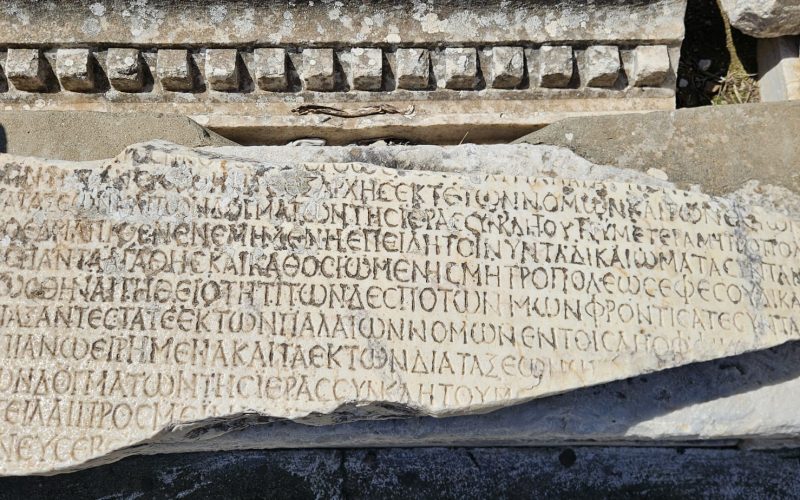
Toggle1) The main words and phrases that can be deciphered in the inscription are as follows:
• ἐκ τῶν νομοφυλάκων = “among the nomophylaks / among the guardians of the law”
• δικαιώματα = “rights, privileges, legal powers”
• μητροπόλεως Ἐφέσου = “Ephesus metropolis / metropolitan city Ephesus”
• θεότητι τῶν δεσποτῶν ἡμῶν = “to the divine glory of our lords / to the divine imperial authority”
• φροντίσαντες = “care by showing, by paying attention”
• παλαιῶν νόμων = “old laws”
• ἐπιμεληθέντα / ἐπιμεληθέντες similar forms = “observed, regulated, supervised”
• διατάξεων = “regulations, decrees, judgments”
• probably δόγματα = “decisions, official judgments”
• probably ἱερᾶς συγκλήτου = “holy senate”
When these are put together, the estimated reading is:
• Confirmation of some of Ephesus‘s ancient rights and legal status,
• Protection of these rights through laws, senate decisions, or imperial regulations,
• Supervision and enforcement of these rights by certain officials or officers.
2) Approximate translation of the visible and readable parts.
Based on the legible parts of the inscription, we can draw the following conclusion.
- … ἐκ τῶν νομοφυλάκων καὶ τῶν …
- … δογμάτων τῆς ἱερᾶς συγκλήτου …
- … ἡμετέρας μητροπόλεως …
- … τῶν ἰδίων δικαιωμάτων …
- … καθωσιωμένης μητροπόλεως Ἐφέσου …
- … τῇ θεότητι τῶν δεσποτῶν ἡμῶν …
- … φροντίσαντες …
- … τῶν παλαιῶν νόμων …
- … ἐπιμεληθέντα …
- … τῶν διατάξεων …
- … τῶν δογμάτων τῆς ἱερᾶς συγκλήτου … Two statements in particular are very important here:
a) ἐκ τῶν νομοφυλάκων
This refers to a group of officials in the city who maintained law and order. Nomophylakes, literally, are “law keepers/law enforcers”.
b) μητροπόλεως Ἐφέσου
This statement almost explicitly indicates that the inscription belongs to Ephesus. It was very common for Ephesus to emphasize itself as a “metropolis” during the Roman Imperial period and especially in Late Antiquity.
3) Predicted Academic Translation Essay
The following text is not a word-for-word translation, but an interpretive academic translation based on legible fragments:
“… among the lawkeepers and…
… by the decisions of the sacred senate and of our metropolitan city…
… in terms of their own rights and legal authority…
… for the consecrated/officially recognized metropolis of Ephesus…
… in accordance with the divine glory of our lords…
… by taking care and keeping the old laws in mind…
… those who supervise and regulate these…
… according to the regulations and decisions…
… in accordance with the provisions of the sacred senate…”
4) More fluent meaning
“The lawkeepers and relevant officials, taking into account the decisions of the sacred senate and the ancient rights and privileges of the metropolitan city of Ephesus, have exercised the necessary oversight for the preservation and implementation of this legal order. The purpose of this text is to confirm Ephesus’ legal status as a metropolis, its traditional laws, and its privileges guaranteed by official regulations.”
5) The possible subject of the inscription.
1. Protection of Ephesus’s legal privileges
The word δικαιώματα in the text strongly suggests this.
The meaning here is not ordinary “right”; rather, it means:
• Historical privilege,
• Official authority,
• City status,
• Institutional privilege.
2. City administration and civil service
The expression νομοφύλακες indicates that this relates to practical administration. This inscription is not merely an honorary inscription; it also carries the language of practice and administration.
3. Mentioning both old laws and new regulations together.
The inscription states both:
The presence of words like
• παλαιῶν νόμων (“old laws”)
and
• διατάξεις / δόγματα (“regulations / decisions”)
Suggests that the traditional aspect of law from the past and current official approval are processed together.
4. Imperial legitimacy
The expression τῶν δεσποτῶν ἡμῶν is frequently seen, especially in late Roman/early East Roman official style. This expression is mostly used for emperors:
“our lords” = emperor(s).
This suggests that the inscription may not only be an intra-city text but also a document related to imperial approval.
6) Careful consideration of dating.
Stylistically, the inscription probably fits better into:
Late Roman Imperial Period or Late Antiquity.
The factors causing this are:
• The emphasis on μητρόπολις / metropolis,
• Later official language features such as δεσπόται ἡμῶν,
• The density of legal-administrative formulations.
Therefore, a rough estimate of the 3rd–6th centuries AD can be considered; however, this is only an epigraphic style estimate, not a precise date.
7) Philological notes
νομοφύλακες
Describes officials associated with overseeing law and order in ancient cities.
• “Law keepers”
• “Guardians of the law”
• “Overseers of the legal order”
can be translated as follows.
δικαιώματα
This word probably means:
• rights,
• legal powers,
• historical privileges,
• institutional privileges.
μητρόπολις Ἐφέσου
This highlights Ephesus’s position not only as a city but also as a superior regional and administrative center.
θεότης τῶν δεσποτῶν ἡμῶν
• “the divinity / divine glory of our lords”
It is also possible to translate this more accurately into Turkish in a formal context as:
• “the sacred glory of imperial authority”
παλαιοὶ νόμοι
This expression demonstrates the importance of old law in the city’s collective memory. In other words, even new decisions are tied to the old chain of legitimacy.
8) The most likely holistic meaning
The main message this inscription likely aims to convey is:
“The traditional legal rights and privileges that Ephesus possessed as a metropolis were preserved and enforced on the basis of ancient laws, senate decisions, and imperial regulations; the relevant public officials also assumed responsibility for maintaining this order.”