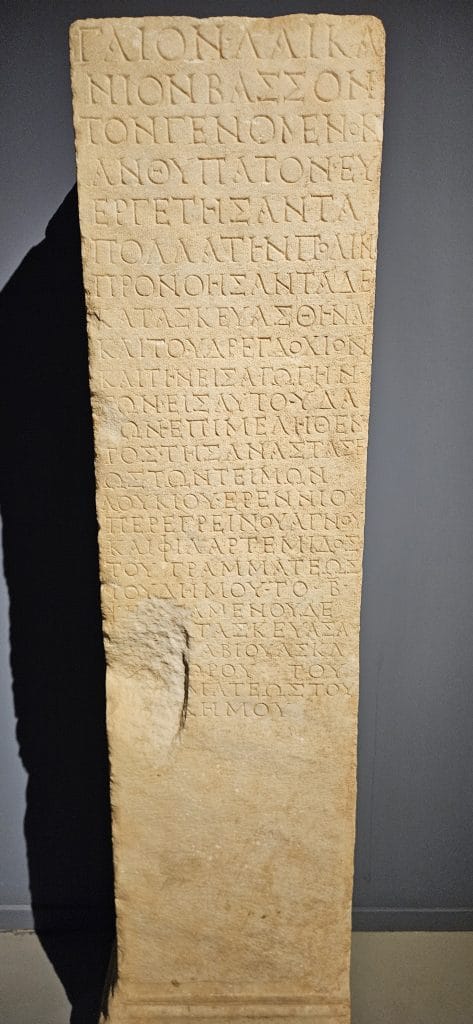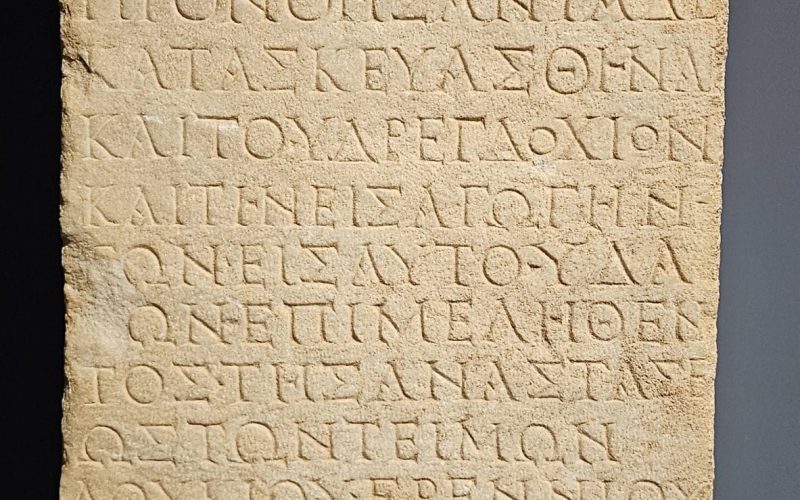
“They honored Gaius… Bassos,
who had been proconsul (provincial governor),
who had done many good deeds for the city,
and also
who had ensured the construction of the passage
and the entrance road/entrance to it.
The construction of this structure was carried out under the supervision of Lucius Erennius Peregrinus…
and Philartemis, the secretary of the demos (people’s assembly/municipal community).”
This inscription is an honorific prepared to honor an important administrator who served a city during the Roman period. The person mentioned in the text is most likely a Roman state official named Gaius… Bassos. The inscription states that he served for a time as an anthypatos, or proconsul. This title was a very high office in the Roman provincial system; especially in important regions such as the province of Asia, proconsuls were very powerful figures both administratively and politically.
The most striking aspect of the inscription is that this person is described not only as someone who held an official position, but also as a benevolent administrator who benefited the city. The expression “euergetesanta,” meaning “benefactor, one who has provided benefit,” is a very important concept in ancient cities.
Because when an administrator or wealthy person contributed money, buildings, ornamentation, or public services to the city, the city’s inhabitants honored them with such inscriptions. Here, it is clearly stated that Bassos provided many benefits to the city.
The inscription also states that he specifically commissioned the construction of a passageway and an associated entrance. One of the words in the text is “diexodos,” meaning passageway, exit, or connecting road. The other is “eisagoge,” meaning entrance, a path leading inside, or an entrance area. This shows us that Bassos was not merely a symbolic figure but actually commissioned an architectural or public arrangement that served a purpose in the city.
In ancient cities, such entrances could sometimes be a gate structure, sometimes a passageway leading to a courtyard, and sometimes a connection to a ceremonial road. Therefore, the inscription speaks directly of a contribution to the city’s infrastructure or a public space.
Another important aspect of the inscription is how it shows how the work was carried out. The inscription mentions another person, Lucius Erennius Peregrinus. This person was probably one of the local elites or officials who played a role in the construction or implementation process.
Then comes another very important title: “grammateus tou demou,” meaning secretary of the demos, in other words, the official clerk of the city council or what we might call the municipal secretary. The person mentioned with this title is Philartemis. This detail shows us that the construction or arrangement was not merely the favor of a high-ranking Roman administrator, but was also carried out under the official supervision of the local city administration.
On one side is the high-ranking governor of the province, representing Rome. On the other side are the city officials, representing the local population. The inscription describes how these two sides worked together to provide a public service. So, this isn’t just a list of names; it’s actually a document, carved in marble, detailing the relationship between Roman rule and the local city administration.
“This inscription honors a proconsul who served the city of Ephesus during the Roman period. According to the text, this administrator did many good deeds for the city, particularly ensuring the construction of a passageway and entrance section. Thus, he is remembered not merely as an office holder, but as a benefactor who contributed to the city’s appearance and functioning.
The inscription also states that this work was carried out under the supervision of local administrators and the public secretary. Therefore, we can see both the power of Roman administration and the role of the city council in the same text.”
Ps: Benefactor: A beneficiary is a person who does good deeds for a city, community, or institution, provides financial support, constructs buildings, or offers assistance. Its origin is Latin.
In the ancient world, especially:
• Those who donated money,
• Those who built buildings,
• Those who constructed public structures such as roads, gates, baths, and fountains,
• Those who did good deeds for the public,
These individuals were called beneficiaries in this sense. The ancient Greek equivalent is often: euergetes / meaning “one who does good, a philanthropist”.
The inscription is a typical example of euergeticism from the Roman Imperial period. The person honored here is a Roman administrator holding the title of proconsul. He provided various benefits to the city, particularly commissioning the construction of a gateway for architectural and public use.
The local officials mentioned in the inscription show that this public project gained official recognition within the city bureaucracy. Therefore, the text is both an honorary inscription and an epigraphic source documenting how Roman provincial administration and local city institutions worked together.”
In short, the message of this inscription is:
“This person did not merely perform a duty; he made tangible contributions to the city, commissioned buildings, and was therefore honored by the city.”
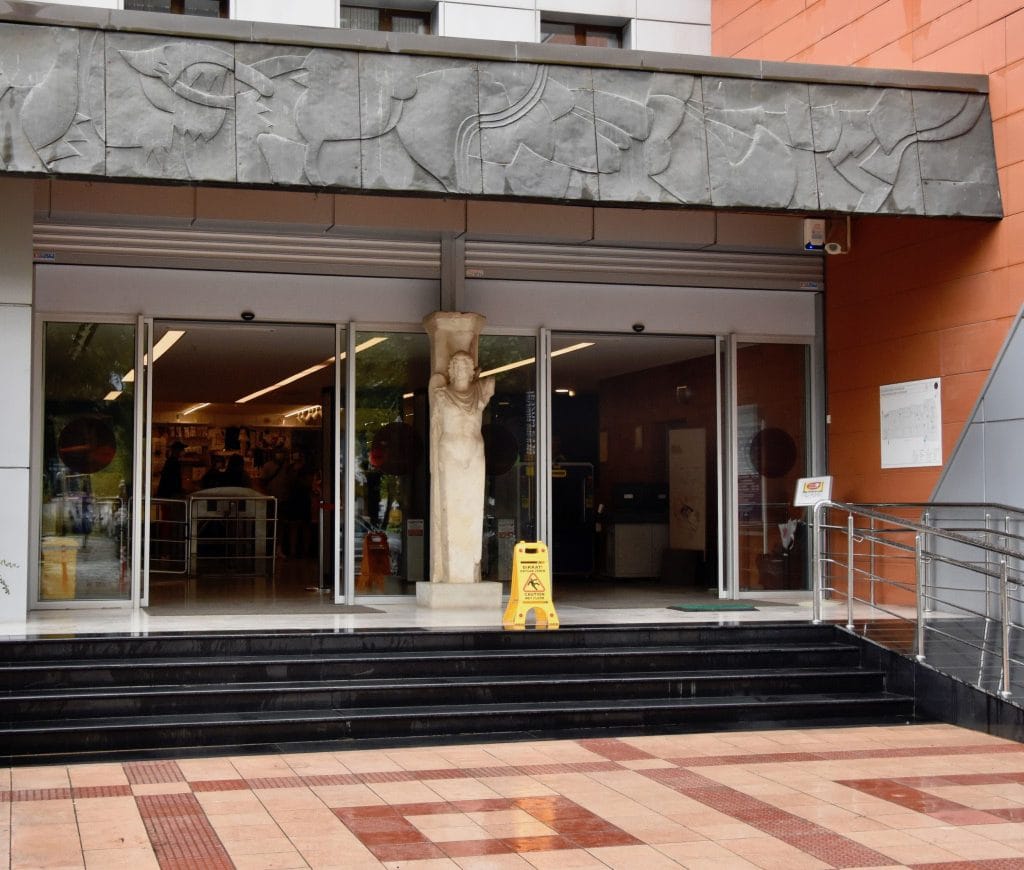
This beautiful and valuable Ephesus inscription is located in the Ephesus Archaeological Museum, at the connection point between Hall 1 and Hall 2, and immediately to the left of the exit of Hall 1. This remarkably well-preserved inscription is most likely a Roman honorary inscription from the 1st–3rd centuries AD, during the Roman Imperial period.