Blog Titles
ToggleThe Two-Sided Inscription in the Commercial Agora of Ephesus
The first side has the most text
The inscription is in Ancient Greek and, in its form, most likely appears to be a type of honorific/public recognition inscription from Ephesus. That is, it describes a person’s services to the city, the duties they undertook, their donations, and the honors bestowed upon them by the public.
General content of the inscription
As far as can be seen in the text, the following elements stand out:
– The person’s loyalty to the city
– Generosity/philanthropy
– Having undertaken some public duties
– Probably donations and expenditures made from his own money
– Praise by the public, council or city institutions
– Religious and civic duties: especially an official-religious title such as stephanephoros.
Some important Greek words that can be discerned on the inscription look like this:
• φιλοτιμία / philotimia → “willingness to serve generously”, “public sacrifice”, “doing good with a sense of honor”
• φιλοπατρία / philopatria similar expression → “patriotism”, “love of country”
• στεφανηφόρος / stephanephoros → an important official-religious magistracy seen in cities like Ephesus
• ἱερεύς / hiereus → “priest”
• δῆμος / demos → “people”
• πόλις / polis → “city”
• Σεβαστός / Sebastos → “Augustus / related to the empire” “respectful title”
• In some lines, a name similar to Κουιντίλιος Ζώσιμος / Quintilius Zosimos seems to be chosen as a personal name
• It could also be a proper name like Ἀππᾶς / Appas
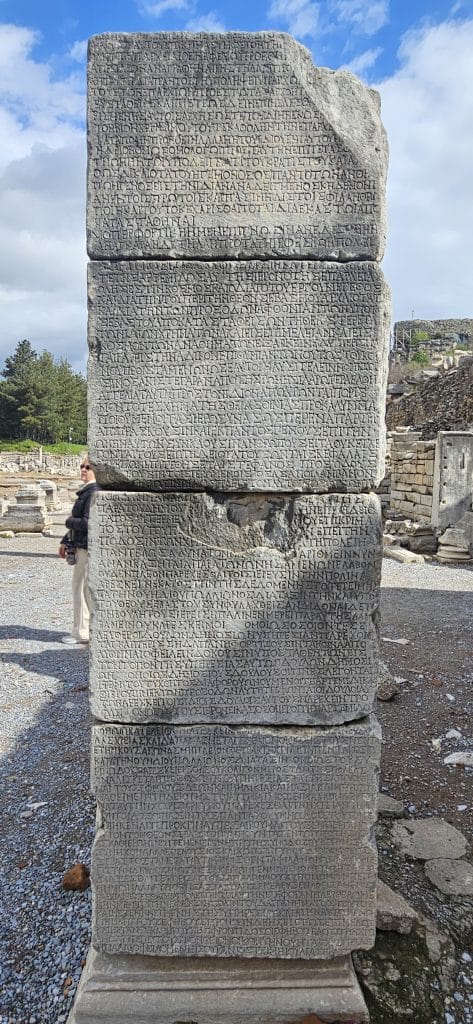
These suggest to us that the text is less a tomb inscription and more an inscription formally honoring a prominent figure of the city. Based on the inscription, the essence of the text can be given as follows:
“This individual was praised for his love of the city, his generosity, and his noble character. He undertook various duties for the benefit of the city, maintained order and the public good, made expenditures at his own expense, and provided benefits to the citizens. He held religious and civic offices, particularly as the Crown-bearer (stephanephoros) and a priest. Because of these services, the people and city institutions honored him and wished to perpetuate his name.”
A more detailed, section-by-section translation of the Great Inscription in the Agora of Ephesus.
1. Upper Section
The first lines seem to praise the individual’s moral character and work for the city.
The tone here is formal and laudatory:
• “goodwill”
• “love of the city”
• “sense of duty”
• “respectable conduct”
• “public benefit”
Such entries are very common in Hellenistic and Roman honorific inscriptions.
2. Middle Section
Here, more concrete services seem to be listed.
Possibly:
• undertaking a specific task
• covering expenses
• making donations for the public good
• perhaps contributing to a building, ceremony, festival, or official business
Since some lines contain expressions related to the empire, it is possible that the individual was a distinguished person serving the city within the Roman imperial order.
3. Lower-middle section
Here, the titles are particularly noteworthy:
• Stephanephoros
• Priesthood
• Possibly other city duties
In Ephesus, such positions were not only religious but also carried high social prestige. Therefore, the inscription shows that the person was not only wealthy but also an elite who took on public responsibilities.
4. Lower section
This could be the concluding part of the decision. That is:
• appreciation by the people or the assembly
• bestowal of honor
• immortalization of his name with an inscription
• perhaps a statue, pedestal, or public visibility
This typically conveys the message that “the city will not forget such a person.”
Probable Type of the Readable Face of the Inscription
This inscription most likely falls into one of the following categories:
• honorary inscription
• city decree
• public thank-you text
• inscription praising a beneficiary
Therefore, the person described here could be a “beneficiary”.
What does beneficiary mean?
In ancient cities, a beneficiary was someone who supported the city with their own wealth, built buildings, distributed grain, financed festivals, undertook public expenses, and spent money for the benefit of the public.
The Historical Atmosphere of This Inscription
In terms of the letter form and content type of the inscription, this type of text is generally very consistent with Roman Imperial Period Ephesian inscriptions. In particular:
• City elites
• Priestly and civil duties
• Imperial titles
• Public honoring
These are very common in Roman period Ephesian inscriptions. General Impression
The texts visible on this face most likely contain:
• Short records relating to different people
• Names of officials
• Formulas indicating year / term of office
• Expressions relating to festivals or sacred areas
• The formula ἐπὶ … meaning “in the year of office of this person” on some stones
In ancient Greek inscriptions, ἐπὶ + person’s name often means
“…in the year of office of … / at the time of …”
So this face seems less like a single narrative and more like short epigraphic fragments added later to the same monument or composed of different blocks.
The second, less legible face of the same inscription.
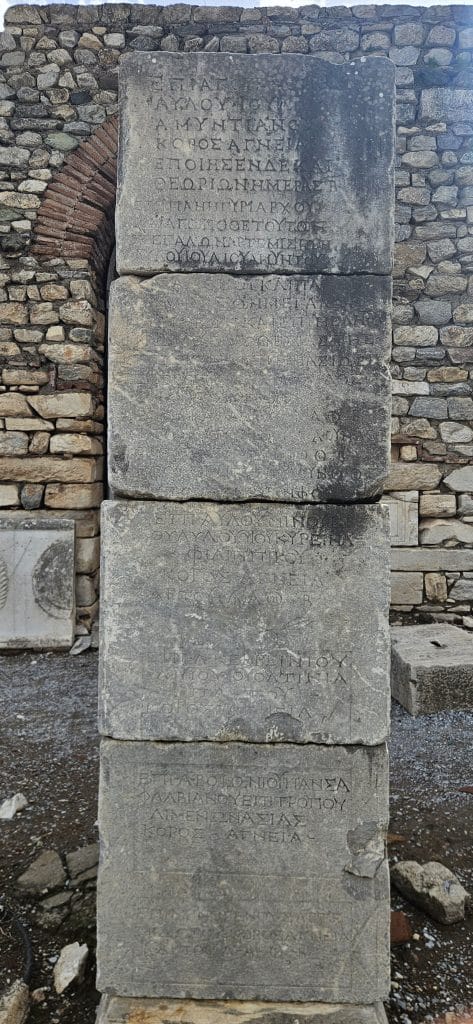
1. Top Block
The readable parts look approximately like this:
• … ΓΛΑΥΚΟΥ / of Glaukos
• … ΑΜΥΝΤΑΣ / Amyntas
• … ΕΠΟΙΗΣΕΝ / did, built, had built
• … ΘΕΩΡΙΩΝ / theoroi / holy apostles, official festival committee
• … ΠΑΝΗΓΥΡΑΡΧΟΥ / panegyriarkhos, festival head / festival director
• … ΑΡΤΕΜΙΣΙΩΝΙ / in the context of Artemis / related to Artemis
The meaning derived from this block:
Here, a person’s name is mentioned, followed by:
• that he/she did / had something done
• that this was a festival / holy ceremony
• or the cult of Artemis
• and seems to be associated with the title of panegyriarkhos, an official title.
Possible translation:
“… Amyntas, son/descendant of Glaukos, did this / had it done … on the day of theoroi / on the occasion of the holy assembly … as panegyriarkhos … at the Artemision…”
The ἐποίησεν here is very important; because it means “made, built, had it done”. So this block is most likely a record of a construction/vow/arrangement.
2. Middle top block
This block is very faint. A few letters are visible on the right. The clearest thing is that this is also a short record. Most likely a continuation of the formula above or a separate second record.
A full translation here would not be accurate; many letters are missing.
This section contained an ambiguous translation:
• Person’s name
• Perhaps a father’s name
• Perhaps a title
• And a short description
but it is not clearly legible.
3. Middle block
The most striking part here:
• ΕΠΙ ΑΠΟΛΛΩΝΙΟΥ … → “In the time of Apollonius / In the year of Apollonius’s tenure”
• … ΥΙΟΥ … → “son”
• … ΚΥΡΕΙΝΑ / ΚΥΡΕΙΝΑ?
• ΦΙΛΙΠΠΙΚΟΥ → “Philippikos”
• again near the last line:
• … ΑΓΝΕΙΑ …
What does it mean? This looks like a very typical administrative formula:
“In the year of Apollonius’s tenure, … son of …, Philippikos…”
So here, it probably includes:
• The person in office
• His father / lineage
• Perhaps a second name or nickname
• And a short official record.
Possible translation of the meaning:
“In the year of Apollonius’s reign, … son of …, Philippikos …”
The rest is illegible due to wear and tear.
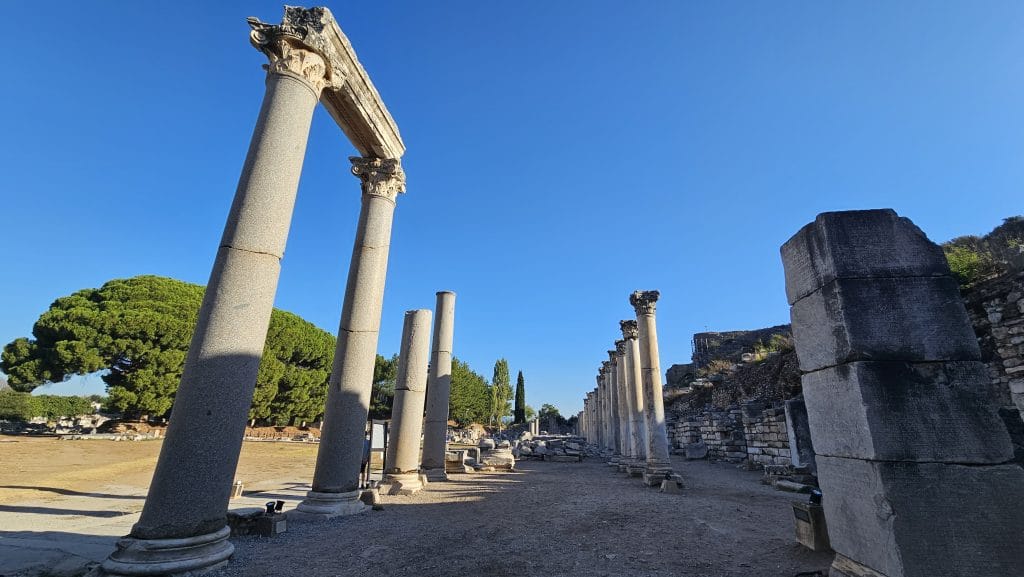
4. A sub-block
The parts that can be read here:
• ΕΠΙ … → again “…in the time of / …in the term of office”
• ΔΙΟΝΥΣΙΟΥ → “of Dionysios”
• again short broken phrases at the end
Possible meaning
This also seems like another year/term of office record.
Estimated meaning
“In the term of office of Dionysios…”
This formula shows us that there are more than one small record in the same percentage.
5. Sub-block
The most important lines that can be read here are as follows:
• ΕΠΙ ΑΠΟΛΛΩΝΙΟΥ … or a similar name
• ΦΛΑΒΙΑΝΟΥ ΕΠΙΤΡΟΠΟΥ → “Flavianus, epitropos / overseer / administrator / deputy”
• ΛΙΜΕΝΟΣ → “of the harbor / belonging to the harbor”
• Broken lines again at the end
This block is very important.
Because the word ἐπιτρόπου seems to be selected here.
This word means:
• Deputy
• Administrator
• Supervisor
• A trustee-type official
and if it is also read as λιμένος, this directly suggests:
• Port
• Port administration
• A port-related duty
possible translation
“…in the year of office… Flavianus, while he was the administrator/supervisor… of the port…”
This is very meaningful for a port city like Ephesus.
The meaning of the important words in this percentage:
ἐποίησεν
“He did, he had done, he built.”
If this word appears on a stone, it often has the context of:
• having a structure built,
• offering a sacrifice,
• making an arrangement.
θεωροί / θεωρίων
Holy messengers, official religious delegation, holy pilgrimage / festival officials.
πανηγυρίαρχος
Festival president, festival manager.
This official:
• organizes the festival,
• supervises ceremonies and public performances,
• sometimes covers the expenses.
ἐπὶ + noun
“…in the year of office of / …in the time of.”
This is a very common official chronogram formula.
ἐπίτροπος
Supervisor, deputy, manager, administrator.
λιμήν / λιμένος
Port.