Blog Titles
ToggleHighlights of Ephesus Tour (Private and Full-Day) Itinerary
Your guide from your meeting point will pick you up. Your first stop will be the Temple of Artemis, where you will spend about 15 minutes. You will enter Ephesus from the upper city of ancient Ephesus ruins with your guide. You will be admired by;
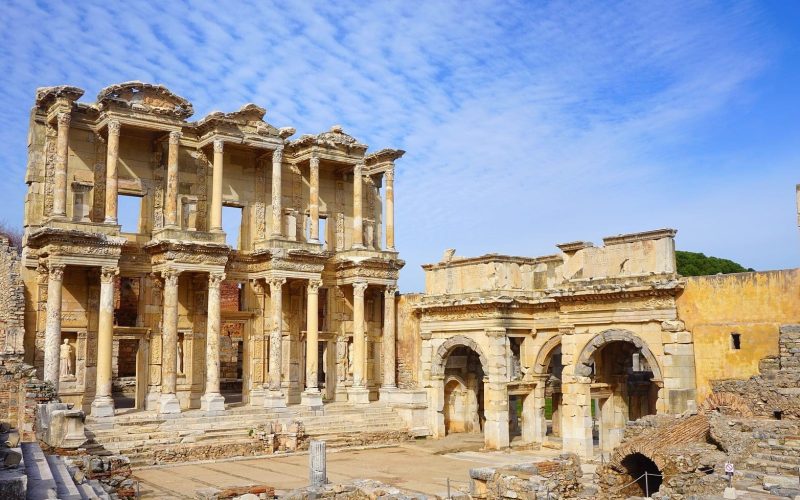
- Celsus Library, which is the highlight and masterpiece of Ephesus
- The largest Greco-roman theater of the Ancient World
- Hadrian Temple
- Terrace Houses
- The Marble Street
- The Odeon
- The Temple of Domitian
- Celsus Library
- The Commercial and State Agora
- Experience Museum
When you visit the Ephesus Archeological site, you will see the Terrace Houses of Ephesus, which were the ancient Luxury Rich Roman homes.
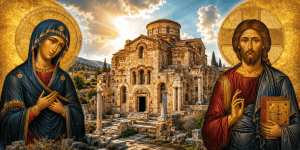
Then you will go to the House of the Virgin Mary, where she spent her last years. Pope Paul VI, Pope John II, and Pope Benedict had been and joined the services. That means it is still an active chapel.
After you all have seen the sites, you will have your lunch in a local Turkish restaurant with delicious homemade Turkish food. There are options for vegetarians and gluten-free.
Sites to Visit
- Temple of Artemis: One of the Seven Wonders of the Ancient World.
- Ancient City of Ephesus: The largest uncovered Ancient City of Turkey.
- The House of Virgin Mary: The last important person in the House of Virgin Mary was Pope Benedict, who he worshiped.
- Terrace Houses: Rich Romans’ Mansions.
Duration Time
This will be your Private Full-Day Ephesus Highlights Tour, which means the duration of your tour depends on your interest. For the general idea, you will spend about 6 or 7 hours on this tour.
Recommendations: There are uneven ancient streets in Ephesus, so please have your comfortable shoes and clothing, If you visit in summer, please get your hat and sunblock creams and water.
Tour Prices
Highlights of Ephesus Tour price is changing according to the number of adults. Please ask the price.
Children aged seven and under can enter Ephesus and other historical sites around Ephesus free of charge. You must present an ID, passport, or a photo of these documents to show your child’s age at the entrance.
PS: We would like to introduce to you the local cultural aspects of Ephesus, showing handmade Carpet and rug Art Weaving Teaching–Village, and Ceramic Center or Leather Company – An Opportunity Not To Be Missed!
Ephesus, located near Selçuk in İzmir, is an important Ionian city and one of the most magnificent cities of antiquity. It flourished particularly during the Hellenistic and Roman periods, becoming a center of trade, religion, and culture. The city is famous for its monumental structures such as the Celsus Library, the Great Theatre, the Marble Street, and the Terrace Houses. The Temple of Artemis, considered one of the Seven Wonders of the World, is also one of Ephesus’ greatest symbols. Ephesus is of great importance not only politically and economically but also in terms of early Christian history; therefore, today it is considered one of Turkey’s most valuable ancient cities in terms of both history and archaeology.
The House of the Virgin Mary, located on Bülbüldağı mountain near Selçuk, is an important pilgrimage site considered sacred in the Christian world. According to traditional belief, Mary, the mother of Jesus, spent her final years here with Saint John.
The structure is a small stone chapel. Its location was discovered in the 11th century based on descriptions by the German mystic Anne Catherine Emmerich. It is a sacred pilgrimage site for Catholics and Orthodox Christians. Pope Paul VI, John Paul II, and Benedict XVI visited it. Inside, there is a prayer area, and outside, a holy water source and a wishing wall.
Today, the House of the Virgin Mary is one of the most important pilgrimage sites in the Ephesus region, both religiously and culturally.
The Terrace Houses of Ephesus were a luxurious residential area where the wealthiest and most distinguished families of the ancient city lived. They were called “Terrace Houses” because they were built on a hillside. These houses featured mosaics, frescoes, marble cladding, and advanced water heating systems. Therefore, this is one of the places that best reflects the daily life and wealth of Ephesus.
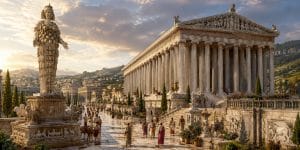
The Temple of Artemis is the most famous structure in Ephesus and is considered one of the Seven Wonders of the Ancient World. It was built in honor of the goddess Artemis and demonstrated both the religious and economic power of Ephesus. The temple was very large, made of marble, and extremely magnificent for its time. Although very few remains of the temple today, in antiquity it was a sacred center that attracted people from all over the world.
It was located near Ephesus.
The first major structures developed during the Archaic period, its most famous form being built in the 6th century BC.
It was not only a place of worship but also a sacred area where refuge and rich offerings were collected.
The Ephesian Artemis is somewhat different from the huntress Artemis in the Greek world; she is more associated with fertility, procreation, and protection.
Beautiful stories about Artemis Temple:
1-The story of Herostratus’s burning
One night, the temple was burned by a man named Herostratus who wanted to immortalize his name. According to ancient sources, this event coincided with the night of Alexander the Great’s birth. Therefore, tour guides often tell a symbolic story such as, “Artemis wasn’t in Ephesus that night; she was helping Alexander give birth.”
2-Alexander the Great’s Offer of Repair
After the temple burned down, Alexander the Great wanted to provide funds for its reconstruction. However, the Ephesians gracefully declined the offer, saying, “It is not fitting for one god to build a temple for another god.” This story beautifully illustrates the pride of the people of Ephesus and the sanctity of the temple.
3-Artemis Seen as a Protective Mother Goddess
In Ephesus, Artemis was not just the goddess of hunting. The people saw her as the protector of the city, the source of fertility and life. Therefore, those who came to the temple not only prayed but also offered sacrifices, asking for help and protection. This made the temple not only an architectural center but also an emotional and sacred one.
4-The Story of the Connection with the Amazons
In some ancient narratives, the founding of Ephesus and the cult of Artemis are associated with the Amazons. Legend says the Amazons, warrior women, held Artemis in great reverence. This story is not historically certain, but it is a beloved legend in ancient narratives that enhances the mysterious atmosphere of Ephesus.