Chronology of Religions in Ephesus
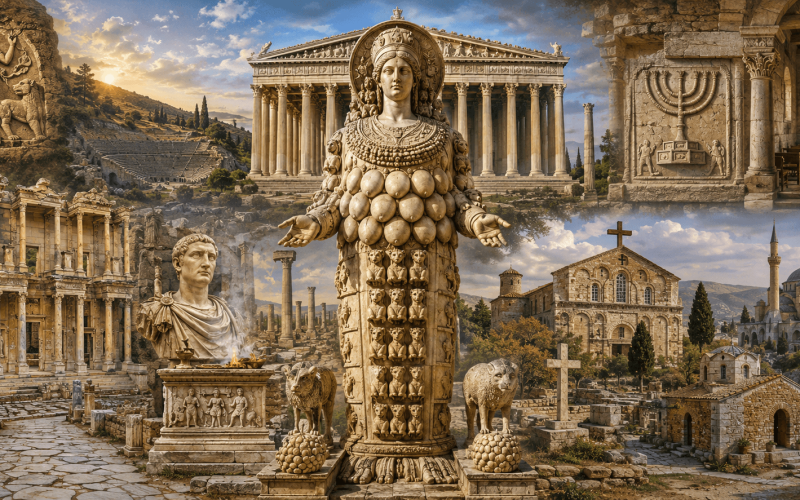
Religions in Ephesus didn’t change overnight. The religious history of Ephesus is like a series of overlapping layers: first the Anatolian mother goddess, then Artemis, then the Roman imperial cult, then Judaism and Christianity, and later, the Islamic/Seljuk legacy.
1. The Oldest Layer: The Mother Goddess / Kybele-Meter
The religious roots of Ephesus are even older than the Greeks. It is believed that the sacred area in the region has been connected to the Anatolian mother goddess belief since very ancient times. Documents suggest that the religious continuity seen in Ephesus can be traced from the Kybele/Meter cult to Christianity.
In fact, the origins of the Ephesus Artemis sanctuary are traced back to at least the 2nd millennium BC and initially bore the character of the “Anatolian mother goddess.
” Even before Ephesus became famous for its grand marble streets, people considered the power of nature, fertility, birth, and the idea of a protective goddess sacred. In other words, the religious spirit of Ephesus was primarily not the “city goddess,” but the idea of earth, fertility, and the mother goddess.
2. The Heart of Ephesus: Artemis Ephesia
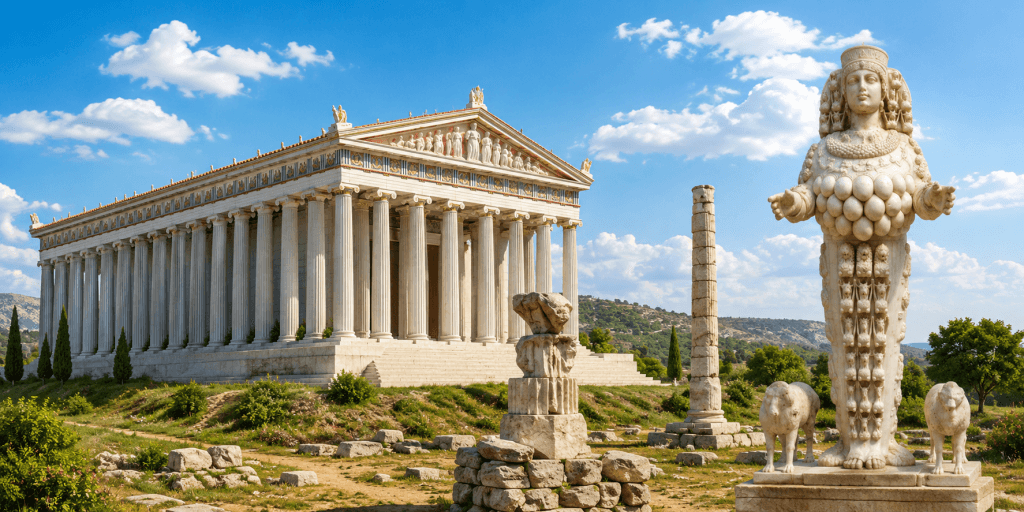
Then this ancient belief in the mother goddess continued under the name Artemis with Greek influence. But the Artemis of Ephesus was somewhat different from the huntress Artemis in Athens or in classical Greek mythology. The Artemis in Ephesus was more like the mother of the city, its protector, a symbol of fertility and order.
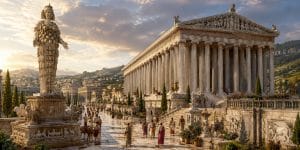
The Temple of Artemis was not only a place of worship; it was also the economic, political, and social center of Ephesus. The temple was considered one of the Seven Wonders of the Ancient World; accepted documents state that the temple was used as a sacred site from the 11th century BC, that construction of the great temple began around 570 BC, that it was entirely made of marble, and that it had 127 columns, each approximately 18 meters high.
In Ephesus, the religion of Artemis was not merely about “praying to the goddess.” Pilgrims, merchants, artists, priests, and administrators who came to the temple boosted the city’s economy. Therefore, for Ephesus, the cult of Artemis represented, in today’s terms, faith, tourism, commerce, and the city’s identity.
3. Roman Period: Gods + Emperor Cult
During the Roman period, Ephesus became one of the most important centers of the Asia province. Rome generally incorporated local gods into its own system rather than eliminating them. Therefore, Artemis was still important in Ephesus, but the Roman emperor cult also strengthened alongside her.
The imperial cult meant that the Roman emperor or imperial family was not merely a political leader, but a figure revered as a sacred figure. Structures such as the Temple of Hadrian and the Serapeion in Ephesus, along with other monumental buildings from the Roman period, demonstrate this multi-religious structure.
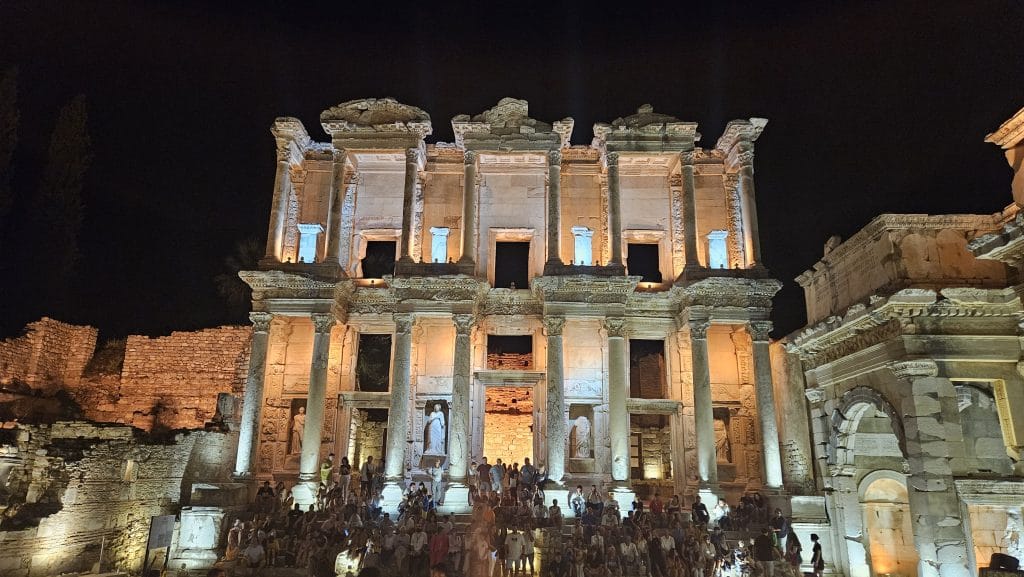
Documents indicate that Ephesus represents the Roman Imperial period culture through structures such as the Library of Celsus, the Temple of Hadrian, the Serapeion, and the Terrace Houses.
In short, someone from Ephesus could offer sacrifices to Artemis in the morning, attend a ceremony in the emperor’s name at noon, and be interested in the Egyptian cult of Serapis in the evening. In the ancient world, religions were not as sharply divided as they are today; people could show respect to more than one sacred power.
4. Beliefs of Egyptian Origin: The Influence of Serapis and Isis
Ephesus was a port and trading city. Being a port city meant income not only from goods but also from ideas and religion. Therefore, cults of Egyptian origin, such as those of Serapis and Isis, reached Ephesus. The structure called Serapeion is seen as one of the traces of this mixed Egyptian-Roman religious atmosphere. The fact that documents specifically mention the Serapeion among the Roman-era cultural structures in Ephesus demonstrates this diversity.
Ephesus was not just the “city of Artemis”; during the Roman period, it was practically a marketplace of religions.
5. Traces of Judaism
The presence of a Jewish community in Ephesus is known. One of the most famous archaeological traces is the menorah/seven-branched candelabra markings seen around the Celsus Library. These markings are important symbols suggesting the presence of a Jewish community in the city. Some studies state that while a synagogue has not been fully excavated in Ephesus, the traces of the menorah indicate a Jewish presence.
Judaism was not as dominant in Ephesus as Artemis; however, because the city was international, Jewish merchants, families, and communities lived there.
6. Christianity: The period that changed the religious destiny of Ephesus
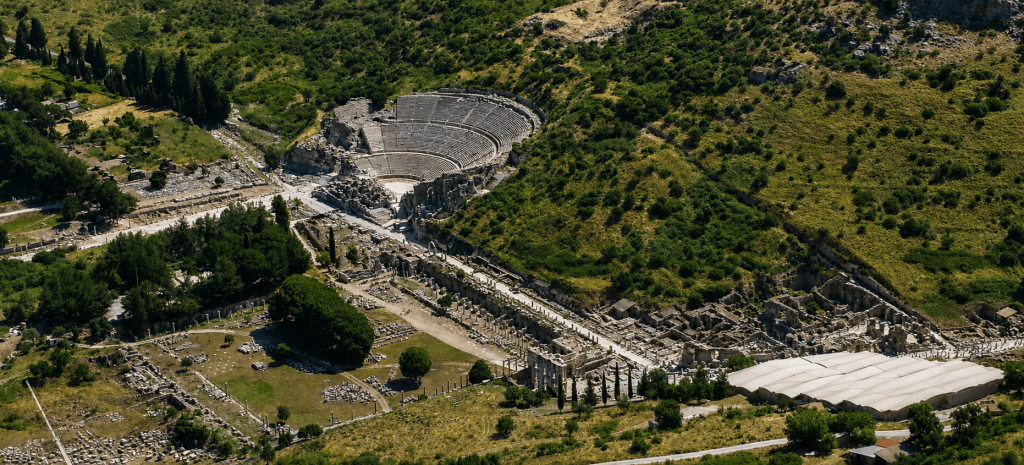
From the 1st century AD onwards, Christianity arrived in Ephesus. It is said that Saint Paul was active in Ephesus. The most famous event is the revolt of Demetrius, a silversmith. In Acts 19, it is recounted that Demetrius earned money by making silver temples to Artemis, and that Paul’s idea that “gods made by hand are not gods” threatened this trade. The crowd rushed to the theater and shouted for a long time, “Great is Artemis of the Ephesians!”
Demetrios worked in his workshop, making small statues and figurines of Artemis. Pilgrims visiting Artemis bought them, and Demetrios made a considerable amount of money from this business.
Then someone came and said:
“Handmade gods are not true gods.”
Demetrios didn’t just hear this as a religious saying. He thought:
“If this belief spreads, my business is over.”
Then he incited the people. The crowd streamed towards the Great Theatre. People shouted:
“The Artemis of Ephesus is great!”
This scene is very important because it’s not just a religious conflict; it’s also a struggle over money, professions, traditions, and urban identity. Christianity didn’t just create religious conflict in Ephesus; it also disrupted the economic order. The cult of Artemis was central to the crafts, souvenir makers, pilgrimage trade, and the city’s pride.
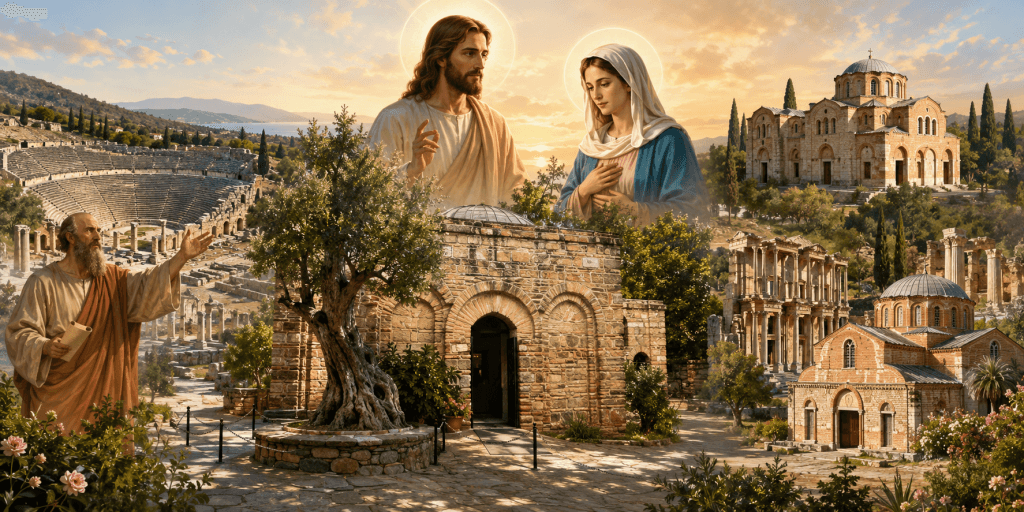
7. The Virgin Mary, St. John, and Ephesus as a Christian pilgrimage center
Documents indicate that the Temple of Artemis attracted pilgrims from the Mediterranean, but by the 5th century AD, this pilgrimage importance had shifted to Christian pilgrimage with the addition of the Church of Mary and the Basilica of St. John.
Important church councils were held in Ephesus in 431 and 449. The Council of Ephesus in 431, in particular, is very important in terms of the position of Mary in Christian history. Documents indicate that these councils were influential in the development of reverence for Mary, and that this can be read as a kind of historical continuity with older traditions of female sanctity such as Artemis/Cybele.
Once, people came to Ephesus for “Great Artemis.” Centuries later, people began to come to the same region for the Virgin Mary, Saint John, and the Christian sacred heritage. So the sacred center hasn’t changed; only the name of the sacred story has changed.
8. Later Period: Isa Bey Mosque and Islamic Heritage
In the Ayasuluk/Selçuk region, which is a continuation of the ancient city of Ephesus, traces of the Seljuk and Ottoman periods are seen. Documents describe the Isa Bey Mosque and the medieval settlement in Ayasuluk as signs of the presence of Seljuk and Ottoman Turks in the region.
Therefore, the Ephesus area becomes a whole not only with its pagan and Christian past, but also with its later Islamic-Turkish heritage.
The sequence of religions in Ephesus can be described as follows:
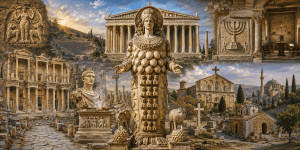
Mother Goddess / Kybele-Meter → Artemis Ephesia → Roman gods and imperial cult → Eastern cults such as Serapis/Isis → Traces of Judaism → Christianity → Seljuk-Islamic heritage
In short, Ephesus is not a place where one religion completely erased another; it is a multi-layered sacred geography where old sacredness continued under new names, pilgrimage routes changed, temples were replaced by churches, and then a new layer was added with mosques and Turkish settlements.