Blog Titles
ToggleThe Temple of Serapis in Ephesus
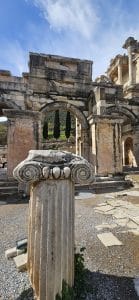
Built near the western gate of the lower agora, the Temple of Serapis was constructed in the 2nd century AD by Egyptian merchants. Sculptures and inscriptions from the Temple of Serapis are housed in the Ephesus Museum and the Izmir Museum. One of the best-preserved structures in Ephesus, the temple has not yet been fully restored. In June 2024, a ground survey was conducted to gather data and information about the current state of the Temple of Serapis in Ephesus. As a result of this research, which lasted approximately one month, a project was created to restore the Temple of Serapis by 2030, giving tourists visiting Ephesus the opportunity to see this extraordinary structure.

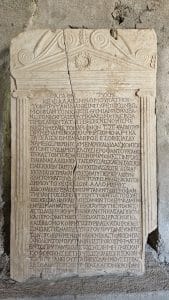
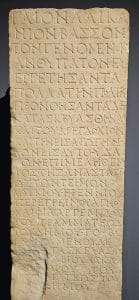
The two-winged doorway is 6 m wide. The deeply carved architectural ornamentation on the lying superstructure fragments exhibits characteristics of the Antonine Period (138-192 AD) Baroque style. The discovery of a fragment of a statue made of Egyptian granite among the ruins, as well as an inscription indicating dedication to those who embraced the Serapis religion, suggests that this monumental structure was a Serapis Temple. During the Christian era, the Serapis Temple was converted into a church. Today, the remains of a baptisterium can be seen in the eastern corner of the temple.
The temple was a magnificent structure, measuring 29 x 20 m by 36 x 70 m, adorned with monolithic columns 14-15 m long. A statue made of Egyptian granite has been found among the temple’s ruins.
The Story of the God Serapis, Famous in Egypt
First, let’s look at the meaning of syncretism. It is a philosophical system that attempts to blend separate thoughts, beliefs, or doctrines.
Religious syncretism, a fusion of traditional Greco-Roman and Egyptian cults, became popular during the Hellenistic period. Among the goddesses who emerged or gained prominence during this period are Isis and Serapis.
First, let’s look at the meaning of syncretism. It is a philosophical system that attempts to blend separate thoughts, beliefs, or doctrines.
Religious syncretism, a fusion of traditional Greco-Roman and Egyptian cults, became popular during the Hellenistic period. Among the goddesses who emerged or gained prominence during this period are Isis and Serapis.
After the death of Alexander the Great in 323 BC, the Greek world entered a period of expanding trade and the spread of Hellenistic ideals across the Mediterranean. At the heart of this new way of life was the Egyptian city of Alexandria, representing a new world of religious syncretism. Alexandria was a center of trade, technology, and academia, and its most intriguing export was Egyptian religion. The Egyptian goddess Isis and the Hellenistic god Serapis became symbols of Greco-Roman and Egyptian religious syncretism. This fusion of religious beliefs defined the overall syncretism of the Hellenistic and Roman periods. This article will examine how Isis and Serapis became symbols of religious syncretism in Greece and Rome.
Religious syncretism is the fusion of various religious beliefs and ideals. Alexander the Great’s conquest of Egypt from Persian control symbolized the end of the Classical period and the beginning of the new Hellenistic age.

Throughout his campaigns and conquests, Alexander used religion as a unifying force between his empire and the lands he conquered. Despite the tension and conflict between Alexander’s empire and the Persians, he respected their traditions and religions. Alexander also offered sacrifices to local gods and wore the clothing of the regions he conquered. When Alexander died in 323 BC, his son Ptolemy of Lagos succeeded him as pharaoh in Egypt and established the Ptolemaic dynasty, which lasted until Augustus defeated Antony and Cleopatra in 33 BC. Ptolemy consolidated his rule in Egypt by promoting the cults and worship of Egyptian gods and introducing Greek gods to the Egyptian people.

Throughout his campaigns and conquests, Alexander used religion as a unifying force between his empire and the lands he conquered. Despite the tension and conflict between Alexander’s empire and the Persians, he respected their traditions and religions. Alexander also offered sacrifices to local gods and wore the clothing of the regions he conquered. When Alexander died in 323 BC, his son Ptolemy of Lagos succeeded him as pharaoh in Egypt and established the Ptolemaic dynasty, which lasted until Augustus defeated Antony and Cleopatra in 33 BC. Ptolemy consolidated his rule in Egypt by promoting the cults and worship of Egyptian gods and introducing Greek gods to the Egyptian people.
The worship of Serapis continued into the Roman period. The Roman Imperial era witnessed the inclusion of Roman gods into the syncretic religious culture of Egypt and Alexandria. Like Greek religion, Roman religion was based on reciprocity and guided by pietas, or piety. The relationships established between the individual and the god were manifested in cult rituals and prayers performed to maintain the balance of the reciprocal relationship. In Greco-Roman society, cults served a social purpose by binding individuals to their communities through shared religious worship.
However, many of these cults were specific to classes or families and were generally reserved for the upper echelons of Roman society. Mystery cults, on the other hand, were open to everyone and freely chosen by individuals. In mystery cults, initiated individuals experienced a unique personal relationship with their gods. As a response to popular social worship and ritual, mystery cults allowed for the development of an individual bond between worshippers and the gods. By the 3rd century BC, Roman religious community had adopted at least one new cult, namely the cult of Cybele.
After Rome annexed Egypt, religious ideas from Rome managed to infiltrate the Alexandrian community. The Roman army played a role in spreading Egyptian and Greco-Egyptian religious beliefs; Roman soldiers often adopted local Egyptian cults and spread them throughout the empire. The Romans assigned new roles to the Egyptian gods, replacing their traditional ones. The most prominent example of this is the transformation of the cult of Iias into a mystery cult.
The Role of the Goddess Isis
In ancient Egyptian religion, Isis (Aset or Eset for the Egyptians) was the wife and sister of Osiris and the mother of Horus. She was famous for searching for and reassembling the body parts of her husband Osiris. Because of this act, she became associated with healing and magic. After entering the Greco-Roman world through religious syncretism, she took on roles attributed to other Greco-Roman goddesses. Isis assumed the roles of goddess of wisdom, goddess of the moon, protector of the seas and sailors, and many more.
However, her most important role was that of the chief goddess of a popular mystery cult. This mystery cult is best evidenced in Apuleius’s Latin novel, The Golden Ass, written in the late 2nd century AD. As part of this religious syncretism, she became the companion of the god Serapis. This relationship with Serapis did not distance Osiris from mythology and ritual, even though Isis and Serapis appear together in iconography as symbols of the royal family.
Isis’s new position in the pantheon, along with her role as mother and wife, attracted more women to her cult than other Greco-Roman goddesses. In Ptolemaic Egypt, female rulers like Cleopatra VII called themselves the ‘new Isis’. By the 1st century AD, the cult of Isis had become well-known in Rome. The success of the Isis cult can be attributed to its unique structure, which did not encourage what the Romans saw as a social custom, such as the cult of Cybele or the feast of Bacchus.

The Mysteries of Isis were first established in Egypt in the 3rd century BC. This cult, inspired by the Greco-Roman Eleusis mysteries, included ritual practices such as initiation rites, offerings, and purification ceremonies. Although a cult founded by Hellenistic peoples, the rites of the mysteries were firmly rooted in ancient Egyptian beliefs. The Mysteries of Isis, like many other mysteries, claimed to guarantee a blessed afterlife for initiates. People went to Isis hoping she would be their savior and allow their souls to live happily in the afterlife.
According to Apuleius’s account of the rituals, Isis herself chose who was worthy of being initiated. The goddess would appear to these individuals in their dreams, and only then could they begin their journey of initiation. After receiving the goddess’s invitation, a person would go to Isis’s temple. There, the goddess’s priests would greet them and read the ritual procedure from a sacred book of magic. Before the ritual could begin, the person had to be ritually purified. Purification involved being washed by a priest and asking the goddess for forgiveness for past sins.

After ritual purification, the individual was given a clean garment and, after offerings to the goddess, they would enter the temple. Ancient sources are unclear about exactly what happened in the temple during the initiation rituals, as the events were intended to remain secret. However, scholars speculate that a variation of the Eleusinian mysteries initiation ritual took place, culminating in the appearance of a bright fire in the center of the temple. Serapis Temple is a very huge temple in Ephesus
Other scholars suggest that the rituals may have involved a reenactment of Osiris’s death and Isis’s role in the myth. However, we will never know exactly what happened in the temple. After the initiation was complete, the new cult member was introduced to the other members and celebrated with a three-day feast and banquet. They were now the custodians of the mysteries of Isis.
Religious syncretism was prevalent not only among Greco-Roman and Egyptian deities but also throughout the Roman Empire. Sulis Minerva was one of the most significant examples of Roman and British religious syncretism. In Bath, Sulis was a local British goddess of thermal springs. However, after her syncretism with the Roman goddess of wisdom, Minvera, she became a protective goddess. Around 130 curse tablets addressed to Sulis have been found in her temple in Bath; this indicates that the goddess was invoked to protect the cursed.
Gallic and Roman syncretism included the gods Apollo Succellos and Mars Thingsus. The Gallic god Succellos was also successfully syncretized with the Roman forest god Silvanus, becoming Succellos Silvanus. Jupiter, the Roman equivalent of Zeus, was transformed into Jupiter Dolichenus, a mysterious cult god with a form of worship that also included Syrian elements.
The Roman period expanded the established tradition of religious syncretism from the Hellenistic period. Many gods from all over the ancient world – including Mesopotamia, Anatolia, and the Levant – were incorporated into the Greco-Roman pantheon. The system of religious syncretism of Greco-Roman and Egyptian religions allowed the inhabitants of Egypt to interact with and worship multiple gods. These new religious values and ideals led to spiritual enlightenment and a new form of worship. Individuals could now develop a unique relationship with their gods, thereby gaining insight and assurance into a blessed afterlife through salvation. This new, salvation-based religious belief would become the foundation of Christianity, the empire’s new religion.