Blog Titles
ToggleBiblical Ephesus Tour (Private and Full-Day) Itinerary
Your guide from your meeting point will pick you up. Your first stop will be the Temple of Artemis, where you will spend about 15 minutes. You will enter Ephesus from the upper city of ancient Ephesus ruins with your guide. You will be admired by;
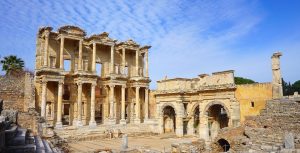
- Celsus Library which is the highlight and masterpiece of Ephesus
- The largest Greco-roman theater of the Ancient World
- Hadrian Temple
- The Marble Street
- The Odeon
- The Temple of Domitian
- The Commercial and State Agora
- Double Church (The Church of Mary) wherein 431 AD. the Third Ecumenical Council was organized.
Then you will go to the House of the Virgin Mary where she spent her last years. Pope Paul VI Pope John II and Pope Benedict had been and joined the services. That means it is still an active chapel.
After you visit all when you are on the way to The Basilica of St. John the Evangelist (where he was buried), you will see the Cave of Seven Sleepers.
Ps: The Seven Sleepers in Ephesus are expected to open during the 2027 tourism season.
After you all have seen the sites you will have your lunch in a Turkish local restaurant with delicious homemade Turkish food. There are options for vegetarians and gluten-free.
Sites to Visit
- Temple of Artemis: One of the Seven Wonders of the Ancient World.
- Ancient City of Ephesus: The largest uncovered Ancient City of Turkey.
- Double Church: First Church of the ancient city of Ephesus.
- The House of Virgin Mary: The last important person who had been in the House of Virgin Mary was Pope Benedict who worshipped.
- Basilica of St. John: The burial place of St. John.
- Cave of Seven Sleepers: The cave where Seven Young Christians slept for about 300 years.
Duration Time
This will be your Private Full Day Ephesus Tour, which means the duration of your tour depends on your interest. For the general idea, you will spend about 6 or 7 hours on this tour.
Recommendations: There are uneven ancient streets in Ephesus, so please have your comfortable shoes and clothing, If you visit in summer please get your hat and sunblock creams and water.
Tour Prices
Private Biblical Ephesus Tour price is changing according to the number of adults. Please ask the price.
Children aged 7 and under can enter Ephesus and other historical sites around Ephesus free of charge. You must present an ID, passport, or a photo of these documents to show your child’s age at the entrance.
PS: We would like to introduce to you the local cultural aspects of Ephesus showing handmade Carpet & Rug Art Weaving Teaching–Village and Ceramic Center or Leather Company – An Opportunity Not To Be Missed!
Ephesus, located near Selçuk in İzmir, is an important Ionian city and one of the most magnificent cities of antiquity. It flourished particularly during the Hellenistic and Roman periods, becoming a center of trade, religion, and culture. The city is famous for its monumental structures such as the Celsus Library, the Great Theatre, the Marble Street, and the Terrace Houses. The Temple of Artemis, considered one of the Seven Wonders of the World, is also one of Ephesus’ greatest symbols. Ephesus is of great importance not only politically and economically but also in terms of early Christian history; therefore, today it is considered one of Turkey’s most valuable ancient cities in terms of both history and archaeology.
The House of the Virgin Mary, located on Bülbül mountain near Selçuk, is an important pilgrimage site considered sacred in the Christian world. According to traditional belief, Mary, the mother of Jesus, spent her final years here with Saint John.
The structure is a small stone chapel. Its location was discovered in the 11th century based on descriptions by the German mystic Anne Catherine Emmerich. It is a sacred pilgrimage site for Catholics and Orthodox Christians. Pope Paul VI, John Paul II, and Benedict XVI visited it. Inside, there is a prayer area, and outside, a holy water source and a wishing wall.
Today, the House of the Virgin Mary is one of the most important pilgrimage sites in the Ephesus region, both religiously and culturally.
The Church of the Virgin Mary in Ephesus, or the Church of Mary, is one of the most important Late Antique Christian structures within the ancient city. Located at the lower entrance of the city, it is particularly known for the Council of Ephesus, convened in 431 AD. This council is crucial for the acceptance of Mary’s title, Theotokos, meaning “God-bearer,” in Christianity.
It is located within the ancient city of Ephesus, but is not the same place as the House of the Virgin Mary.
The structure was used as a large basilica during the Late Antique period. It is one of the most important sacred buildings in Ephesus in terms of early Christian history. It is also notable for its baptistery section.
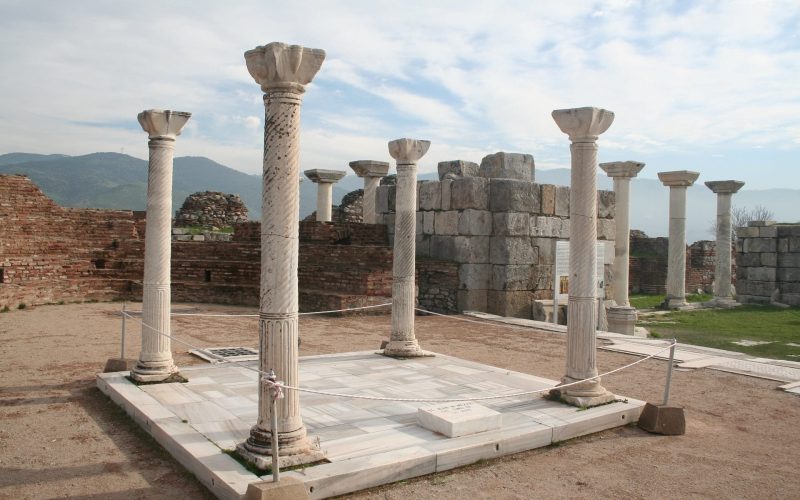
The Basilica of St. John, located on the Ayasuluk Hill in Selçuk, is a very important structure for the early Christian period. According to traditional belief, it was built over the tomb of the Apostle St. John. The structure was rebuilt as a more magnificent basilica in the 6th century during the reign of Byzantine Emperor Justinian I. Although it is now in ruins, it is one of the most important monuments in the Ephesus region in terms of Christian history.