Popular Ephesus Tour Itinerary
You will be picked up by your guide from your meeting point. Your first stop will be the Temple of Artemis, where you will spend about 15 minutes. You will enter Ephesus from the upper city of ancient Ephesus ruins with your guide. You will be admired by;
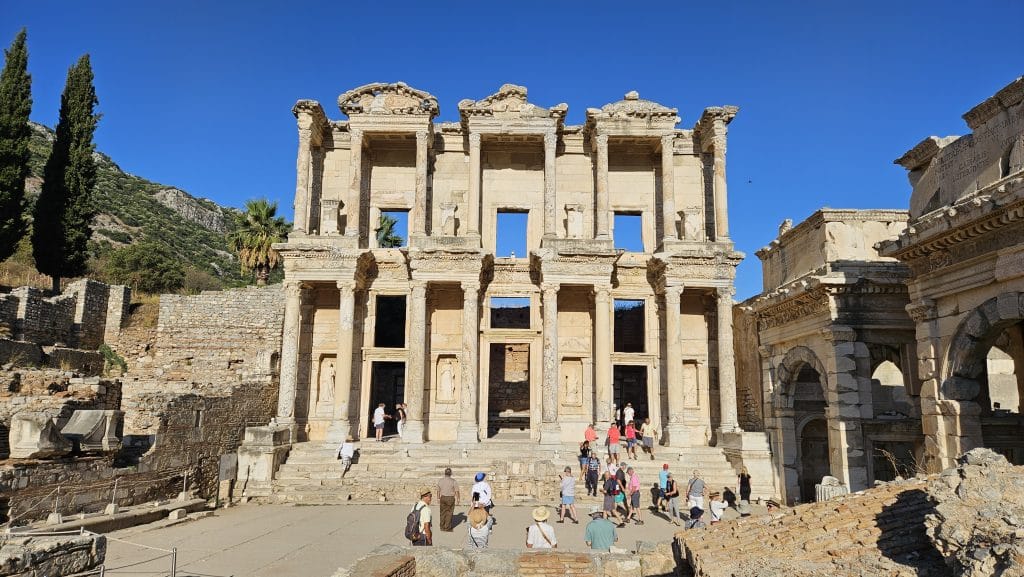
- Celsus Library which is the highlight and masterpiece of Ephesus
- The largest Greco-roman theater of the Ancient World
- Hadrian Temple
- Roman Baths
- The Marble Street
- The Odeon
- The Temple of Domitian
- The Commercial and State Agora
Then you will go to the House of the Virgin Mary where she spent her last years. Pope Paul VI Pope John II and Pope Benedict had been and joined the services. That means it is still an active chapel.
After you all have seen the sites you will have your lunch in a Turkish local restaurant with delicious homemade Turkish food. There are options for vegetarians and gluten-free.
Sites to Visit
- Temple of Artemis: One of the Seven Wonders of the Ancient World.
- Ancient City of Ephesus: One of the best-preserved Greco-Roman Ancient cities and one of the largest open-air museums in the world.
- The House of Virgin Mary: The last important person who had been in the House of Virgin Mary was Pope Benedict who he worshipped.
Duration Time
This will be your Private Popular Ephesus Tour, which means the duration of your tour depends on your interest. For the general idea, you will spend about 4 or 5 hours on this tour.
Recommendations: There are uneven ancient streets in Ephesus, so please have your comfortable shoes and clothing, If you visit in summer please get your hat and sunblock creams and water.
Tour Prices
Private Popular Ephesus Tour prices are changing according to the number of adults. Please ask the price.
Children aged 7 and under can enter Ephesus and other historical sites around Ephesus free of charge. You must present an ID, passport or a photo of these documents to show your child’s age at the entrance.
PS: We would like to introduce to you the local cultural aspects of Ephesus showing handmade Carpet & Rug Art Weaving Teaching–Village and Ceramic Center or Leather Company – An Opportunity Not To Be Missed!

Temple of Artemis in Ephesus
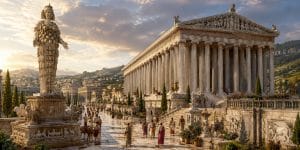
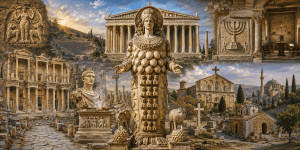
The Temple of Artemis at Ephesus, located near Ephesus in present-day Selcuk, was a vast sacred site considered one of the Seven Wonders of Antiquity. It was dedicated to the goddess Artemis; however, the Artemis of Ephesus was more of an Anatolian goddess of fertility, nature, and mother god, rather than the huntress Artemis of classical Greece. UNESCO also states that the origins of the Ephesus Artemis sanctuary date back to the 2nd millennium BC.
The temple’s most famous large structure was built around 550 BC during the reign of King Croesus of Lydia. According to ancient sources, it was a magnificent temple entirely made of marble, measuring approximately 110 x 55 meters. Its size was considered even more impressive than the Parthenon in Athens. Inside were the cult statue of the goddess, rich offerings, columns, and works of art.
Its most famous story is that in 356 BC, a man named Herostratus burned the temple down, aiming to immortalize his name in history. Interestingly, according to another legend, Alexander the Great was born that same night. Later, the Ephesians rebuilt the temple; it is even said that they politely refused Alexander’s offer of help, saying, “It is not proper for one god to build a temple for another.”
The Temple of Artemis was not only a place of worship; it was also an economic, political, and social center. People offered sacrifices here, sought protection, and gained prestige among cities. The temple was one of the greatest symbols of Ephesus’ wealth and fame.
Today, very little remains of the temple: the foundations, scattered stone blocks, and a single column that has been re-erected. But even that single column reminds us that one of the world’s most magnificent sacred structures once stood here.
“The quiet space we see today is the shadow of one of the greatest temples of the ancient world; the heart of Ephesus once beat here, in the sanctuary of Artemis.”
Ephesus Ancient City
One of Ephesus’ most famous structures is the Celsus Library. This building served both as a library and the mausoleum of Celsus, an important statesman. Its facade is today one of the most recognizable features of Ephesus.
The Great Theatre in the city, with a capacity of approximately 24-25 thousand people, is very impressive. Plays, meetings, and large public gatherings were held in the theatre. The story of St. Paul, mentioned in the Bible, is also associated with this theatre.
One of Ephesus’ main streets was the Street of the Curetes. Along this street were the Temple of Hadrian, fountains, monuments, baths, and wealthy houses. The street was one of the liveliest parts of the ancient city.
Ephesus was also the center of the Artemis cult. The Temple of Artemis, one of the Seven Wonders of the World, demonstrated Ephesus’ sacred and economic power.
Ephesus, with its stone streets, magnificent theater, Celsus Library, and the cult of Artemis, was one of the richest, most cultured, and most impressive cities of the ancient world.
House of the Virgin Mary
The House of the Virgin Mary is a sacred pilgrimage site located on Bulbul Mountain near the ancient city of Ephesus in the Selcuk district of İzmir. According to Christian tradition, after the crucifixion of Jesus, Saint John brought the Virgin Mary to Ephesus, and it is believed that she spent her final years here.
This is not a large and ornate structure, but rather a small, simple stone house/chapel. This simplicity gives the place a peaceful and spiritual atmosphere. In the 19th century, it was researched based on the descriptions of the German nun Anna Katharina Emmerich and gained importance as a sacred place.
Today, the House of the Virgin Mary is visited by both Christians and Muslims. Visitors pray here, leave wishes on the wishing wall, and see the holy water fountains in the surrounding area.
The House of the Virgin Mary, far from the crowds of Ephesus, nestled in the tranquility of Mount Bulbul, is a very special sacred place where faith, peace, and respect converge.