Blog Titles
ToggleEphesus Theater Turkey
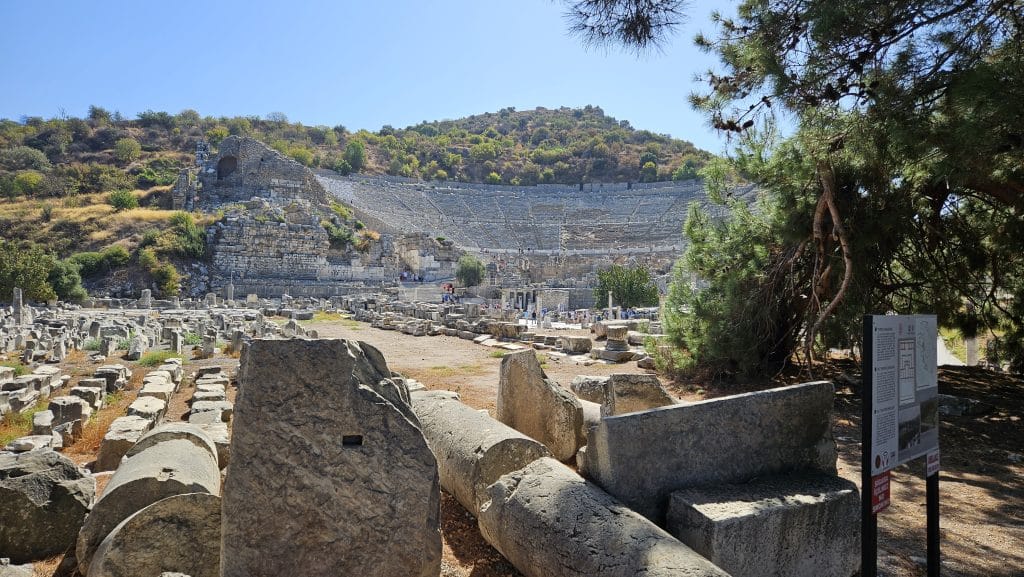
Ephesus Theater had a capacity of 25,000 people and it is the largest theater of the ancient world.
Grand Theatre is one of the most impressive monuments in Ephesus City. The building is located on the western slope of Panayir Mountain and used to overlook the harbor via Harbour Street. This great monument was built in the Hellenistic Period, in the 3rd century BC, during the reign of Lysimachos, one of the generals of Alexander the Great. It was used to celebrate festivals and organize musical and theater events with city meetings.
Grand Theatre was rebuilt several times in different periods of the Greek and Roman eras. The final construction, to expand and form the theatre its current structure that is seen today, started during the reign of Emperor Claudius (41 – 54 A.D) and was completed during the reign of Emperor Trajan (98 – 117 A.D).
The theater had 25,000 people capacity, known as the largest theater in Anatolia. It had sixty-six rows of marble seats, divided by two walkways between seats. Upper section seats were for audiences and there were arched entrances. Important people of the city used lower seats with backs and also imperial seat was located in the lower section. The stage building was three-storied and 18 meters high, Its facade facing the audience was well decorated with reliefs, columns with niches, windows, and statues.
Great Theatre was used for concerts, plays, religious – political-philosophical discussions, and gladiator and animal fights. This theatre is mentioned in Acts 19:29-41 and is known as the place where Apostle Paul preached Ephesians.
The initial construction of the Ephesus Theatre began in the Hellenistic period (3rd century BC). Lysimachus ordered its construction, and the architect who oversaw its creation is known as Zenodoros.
After Ephesus City was destroyed earthquakes and abundant theatre marble were carried away to be used in other constructions. Grand Theater is still used nowadays for concerts in summer. World-famous performers including Elton John have performed in this theatre.
Ephesus Theater Actors
Gollathios: The most interesting player – estimated to be 7 years old. Comedy, Mime and Acrobat artist – he has graffiti in Ephesus. His own name or his stage name is unknown.
Karmiliainos: Mime (Pantomime) artist who worked in Ephesus and Aphrodisias. There is graffiti in Ephesus. His own name or his stage name is unknown.
Sophronia: Mime and Comedy artist – She has graffiti in Ephesus – Her own name or her stage name is unknown.
Menepmoy: Comedy actor – There is graffiti in Ephesus – His own name or his stage name is unknown.
Alektor: Mime artist from Ephesus and has graffiti in Ephesus. His own name or his stage name is unknown.
History of the theater:
The word theatron was used in a different sense by ancient writers. It was first used by Herodotus to mean “spectator community”, and later on, other writers used the word “odeon” to mean conference hall, action place, show place and game, taking into account the function of the building.
The source of the theater is BC. At the end of the 7th century, at the beginning of the 6th century, the people of Athens used to organize festivities celebrating Dionysus, the god of wine, during the vintage season as a thanks for the fruitful product he gave.
In these festivities, the people gathered in a round square (Orchestra), danced around the choir singing lyric songs, and made various shows. These festivals and the choir formed the source of the theater.
Every year, the number of participants in the festivities increased, and this round square was not enough for the public. In order for more people to watch the performances, wooden benches (Ikria) were placed on the slope in front of the round square. It was these rows that later formed the sitting style in theaters (Helence / Theatron – Latin Cavea).
B.C. Drama writers emerged in the 6th century. The dramas written by these authors cover certain mythological subjects. In the narratives, the god, the goddess, comes out of a temple, the titans come out of a cave, and the mortals come out of a house.
How was the first theater built?
A small house was built next to the orchestra to symbolize the place where the protagonist came from, namely the temple, lair or house. This house was later developed and turned into a scene. The date of formation of the stage in the theater is approximately 460 BC. Some writers thought that the reality of the stage building developed from the altar used as the background in Aischylos‘ plays.
In these festivities held in honor of Dionysus, the god of wine, it was seen that two masked persons appeared and performed in addition to the dancers. In this show, one of the actors represented the people and the other the rulers.
The actor representing the public was asking sarcastic questions about the city giants (police) administration to the person in front of him, and the management player in front of the public actor was giving funny answers to these questions.
Thus, the rulers were both criticized and amused. It was these games that led to the emergence of the first comedies in the world. The first dramatic plays were performed for the first time in BC. 5th century BC in Athens. In Pireus from the 2nd half of the 5th century BC. 4th century BC in Epidauros, Erythrai, Megalopolis, Priene, and Magnesia. At the beginning of the 3rd century BC in Ephesus. At the beginning of the 2nd century, it started to be played in Pergamon.
Menander of Ephesus was a very famous writer and wrote plays for performances at the Ephesus Theatre. His fame reached as far as Athens.
The first games were played in the Orchestra. The word orchestra comes from the Hellenic word for dan place (Orchesis). However, after the stage building was built, the plays were taken to the Proskenion section, located just in front of and adjacent to the stage building, and started to be played there.
The proskenion was built 1.5 meters (narrow) and 2.5 meters (high), as the first games were usually played by two people and the game continued as dialogue. After the play was taken to the proskenion, the choir, who made the presentation, direction and finale of the play, remained in the orchestra from the beginning to the end of the play.
B.C. The theaters built until the 1st century were generally tried to be built outside the city, and if they were built somewhere in the city, attention was paid to ensure that this place was in an independent location, outside the street texture of the city. Another point to note is that the place where the audience hall will be located has a view and is sheltered from the wind.
With this, the far environment image is also added to the scene image. M.S. In the theaters built in the 2nd and 3rd centuries, the facade of the stage building (Scenefrons) was elevated, combined with the seating (Theatron), the audience was cut off from the world behind the stage.
Local materials were primarily used as materials in the construction of the theater. Stone, travertine, conglomerate, marble are building materials. For example, marble in the theaters of Ephesus, Priene and Miletos, since marble is easily available by sea, local stone in the theater of Termessos, conglemera in the theater of Hierapolis, travertine and Side and Aspendos theaters, granite in the theater of Heraklia, marble in the cities near the quarry, for example, in Aphrodisias.
Marble was used as a building material. Whether it is from marble or other building materials, the examples in Anatolia always date back to the BC. They belong to after the 3rd century, before the theaters were made of wood.
While researchers were continuing their research on theatres, they defined theaters with sitting rows exceeding a semicircle as Hellenic theaters, and theaters with full semicircular seating as Roman theaters. However, this definition is not an accurate one. The biggest difference between Hellenic theaters and Roman theaters is mostly the differences in the stage building.