Blog Titles
ToggleEphesus Half-Day Tour Itinerary
You will be picked up by your guide from your meeting point. Your first stop will be the Temple of Artemis, where you will spend about 15 minutes. You will enter Ephesus from the upper city of ancient Ephesus ruins with your guide. You will be admired by;
- Celsus Library which is the highlight and masterpiece of Ephesus
- The largest Greco-roman theater of the Ancient World
- Hadrian Temple
- Roman Baths
- The Marble Street
- The Odeon
- The Temple of Domitian
- The Commercial and State Agora
Sites to Visit
- Temple of Artemis: One of the Seven Wonders of the Ancient World.
- Ancient City of Ephesus: One of the best-preserved Greco-Roman Ancient cities and one of the largest open-air museums in the world.
Duration Time
This will be your Private Ephesus Half-Day Tour, which means the duration of your tour depends on your interest. For the general idea, you will spend about 3 or 4 hours on this tour.
Recommendations: There are uneven ancient streets in Ephesus, so please have your comfortable shoes and clothing, If you visit in summer please get your hat and sunblock creams and water.
Tour Prices
Private Ephesus Half-Day Tour prices are changing according to the number of adults. Please ask the price.
Children aged 7 and under can enter Ephesus and other historical sites around Ephesus free of charge. You must present an ID, passport or a photo of these documents to show your child’s age at the entrance.
PS: We would like to introduce to you the local cultural aspects of Ephesus showing handmade Carpet & Rug Art Weaving Teaching–Village and Ceramic Center or Leather Company – An Opportunity Not To Be Missed!
The structures in Ephesus
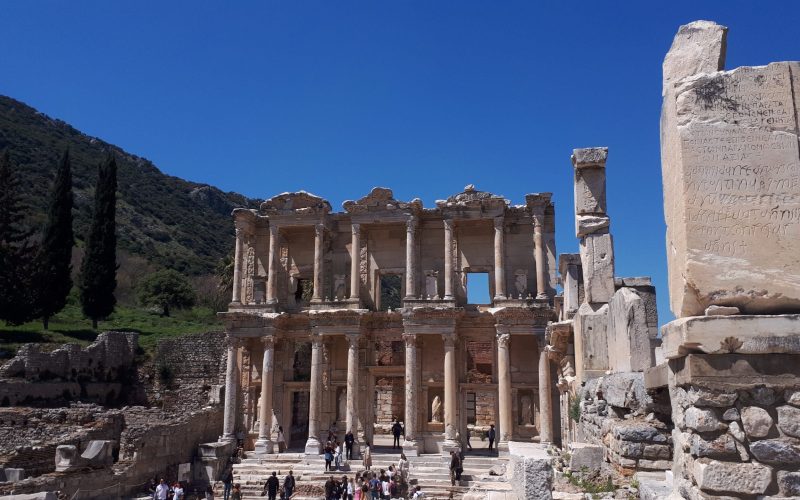
1. Ephesus Celsus Library
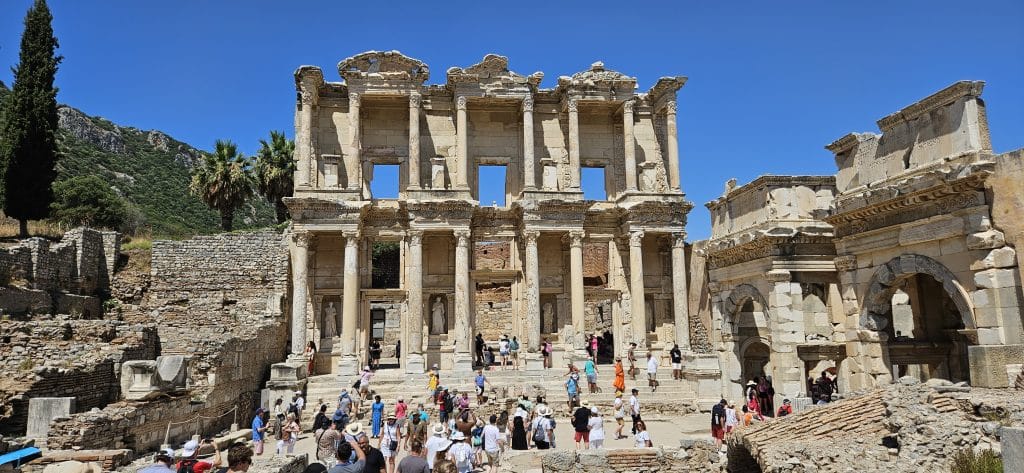
It is the most iconic structure of Ephesus. It was built in the 2nd century AD by Julius Aquila for Tiberius Julius Celsus Polemaeanus, the governor of the Roman province of Asia. This was not only a library but also Celsus’s mausoleum; thus, in Ephesus, knowledge and death were united in the same structure.
The interior measured approximately 10.90 × 16.70 m; parchment scrolls were kept in niches in the walls. The four female statues on the facade represent the concepts of Sophia/Wisdom, Arete/Virtue-Courage, Episteme/Knowledge, and Ennoia/Thought.
“It seems Celsus wanted to live on among books even after death.” Because building a tomb within the city of Rome wasn’t normally easy; but Celsus was a very important person. The library serving as both a tomb and a center of knowledge was meant to immortalize his status. There’s also the architectural illusion on the facade: the building appears larger and more magnificent than it is.
2. The Great Theatre of Ephesus
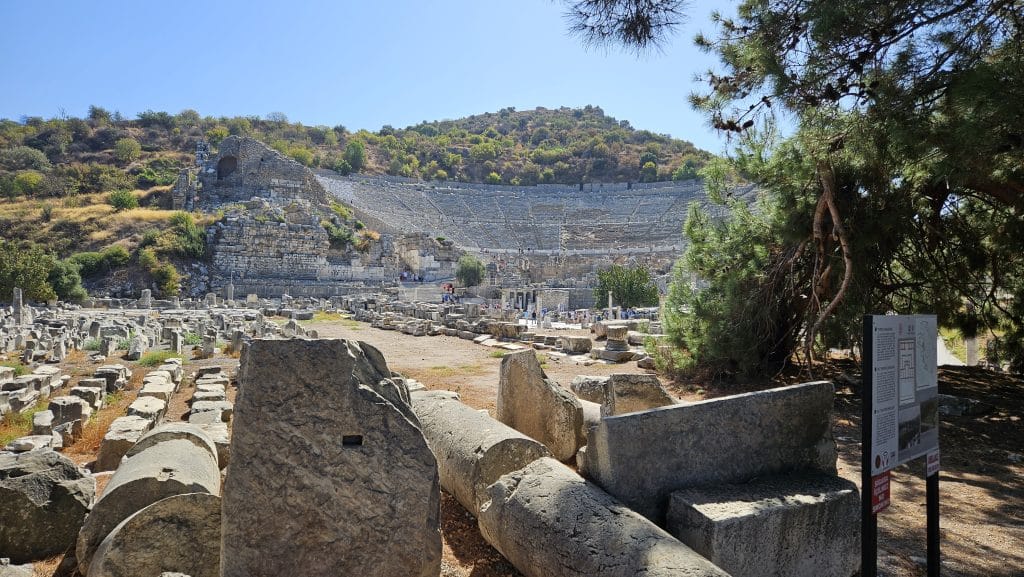
It is one of the most impressive structures in Ephesus. Nestled against the slope of Mount Panayır, it is large enough to accommodate approximately 24,000–25,000 people. Its origins date back to the Hellenistic period, and it was enlarged and monumentalized during the Roman period. The theatre was used not only for plays but also for public gatherings, ceremonies, and some performances during the Roman period.
The famous Ephesian disturbance described in Acts chapter 19 is associated with this theater. Demetrius, a silversmith, and other artisans who made Artemis figurines, feared that the teachings of Saint Paul would weaken the cult of Artemis and their trade. The people rushed into the theater, shouting, “Great is Artemis of the Ephesians!” This event beautifully illustrates how religion, economics, and politics were intertwined in Ephesus.
3. Temple of Artemis / Artemision in Ephesus
This is the main source of Ephesus’s fame. It was one of the Seven Wonders of the Ancient World. Built during the reign of King Croesus of Lydia, around the 6th century BC, the great temple was destroyed by Herostratus in 356 BC and subsequently rebuilt. Measuring approximately 110 × 55 m, this massive temple was not only a religious center but also a center of economy, identity, and prestige. Today, only a few ruins remain on the site; however, in antiquity, it was a major pilgrimage center attracting visitors from all over the Mediterranean.
Herostratus burned down the temple because he wanted to “imprint his name on history.” The Ephesians tried to forbid any mention of his name; but ironically, his name has survived to this day. This story is the origin of the Herostratic concept of fame, used to mean “doing evil for the sake of fame.”
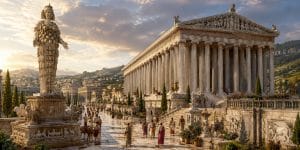
4. Ephesus Street of the Kuretes
This is the most beautiful walking axis of Ephesus. It descends from the Gate of Heracles towards the Library of Celsus. With temples, fountains, monuments, baths, and wealthy houses lining both sides, it was the showcase street of the city during the Roman period. It is believed to have taken its name from the Kuret priests associated with the cult of Artemis.
You could consider this street the “red carpet of Ephesus.” Emperors, governors, the wealthy, priests, merchants, philosophers, slaves, and pilgrims all walked on the same marble stones. The route that tourists walk today was also the city’s most vibrant social scene in ancient times.
5. Temple of Hadrian in Ephesus
One of the most elegant structures on the Kuretes Street. It dates back to the 2nd century AD and was repaired in the 4th century. The originals of the reliefs seen today are in the Selçuk Ephesus Museum; the reliefs in the area are mostly copies. The structure is interpreted as an imperial cult building dedicated to Artemis, Emperor Hadrian, and the people of Ephesus.
The reliefs contain scenes linked to the founding legend of Ephesus. According to the legend, the Athenian prince Androklos asked the oracle of Apollo where to build the new city. The prophecy said, “A fish and a wild boar will show you the way.” One day, while fish were being cooked, a spark ignited a bush, and a wild boar darted out. Androklos followed the boar and found the place where Ephesus would be founded.
6. Ephesus Terrace Houses / Hillside Houses
This is the most important place to understand the wealthy of Ephesus. Terrace House 2, in particular, is a very valuable complex showcasing the lifestyle of the Roman elite. Located on an insula of approximately 4000 m², these luxurious residences are situated on three terraces. Frescoes, mosaics, marble cladding, and private living spaces demonstrate that Ephesus was not only a city of temples and theaters, but also possessed a very wealthy urban aristocracy.
The best thing about the Terrace Houses is the graffiti. The graffiti includes drawings of gladiators, animals, caricatures, names, declarations of love, and even the prices of everyday shopping. So, here we encounter not only wealth, but also the humor, love, gossip, and daily life of ancient people.
7. Ephesus Scholastikia Baths
This is a large bath complex near Kuretler Street. Originally built in the 1st or 2nd century AD, it was renovated in the 4th century by a wealthy Christian woman named Scholastikia. The baths included sections for changing rooms, cold rooms, lukewarm rooms, and hot rooms. Scholastikia’s headless seated statue is still associated with the complex.
Ancient baths were more than just places to bathe; they were like today’s cafes, gyms, social gathering places, and newsrooms. People cleaned themselves there, talked, made business connections, discussed politics, and socialized. Scholastikia’s restoration of the building also demonstrates how influential wealthy women could be in public charitable works during the late antique period.
8. Ephesus Odeon / Bouleuterion
This structure, which appears to be a small theater, was built around 150 AD by Publius Vedius Antoninus and his wife. It had a capacity of approximately 1500 people. It may have been used for concerts and performances as well as council meetings.
While the Great Theatre was like the voice of the people, the Odeon was the venue for more exclusive and private meetings. Here, city administrators, wealthy families, and council members discussed Ephesus’ taxes, repairs, ceremonies, and political decisions.
9. Ephesus State Agora
This was the official square in the upper city. Unlike the commercial agora, it served more as a place for state administration and ceremonies. The Odeon, Prytaneion, and monumental structures surround it. It was like the “official heart” of Ephesus.
For an Ephesian, the agora was not just a marketplace; it was the place where they received news, heard decisions, and witnessed the power of the state. In Roman cities, squares were like propaganda stages built of stone.
10. The Prytaneion and the Sacred Fire of Hestia in Ephesus
The Prytaneion was one of the sacred and administrative centers of the city. The sacred fire of Hestia burned here. This fire symbolized the city’s continuity, spirit of unity, and public identity. Some important examples of the Artemis statues of Ephesus have also been found in this area.
In an ancient city, keeping the sacred fire burning meant the city’s life continued. Taking fire from the mother city when establishing a new colony also conveyed the message, “We share the same roots.”
11. Trajan’s Fountain in Ephesus
It is one of the monumental fountains on the Street of the Kuretes. In Roman cities, water was not only a necessity but also a symbol of imperial power. Structures like the Trajan’s Fountain conveyed the message, “Rome brings you water, order, and prosperity.”
The fountain’s pool contained a statue of the emperor and other decorations. Even while drinking the water, people could sense the emperor’s presence. Therefore, in Rome, fountains formed a very strong link between daily life and political propaganda.
12. The Memmius Monument in Ephesus
Located near Domitian Square, it dates back to the 1st century AD. It is significant for demonstrating loyalty to Rome and showcasing aristocratic family affiliation. The Memmius family wanted to demonstrate their connection to important figures in Roman history through this monument.
We might think of this monument as a “family advertisement in stone,” but it’s much more than that. We can interpret it as both a testament to the fame and power of lobbying in Ephesus and as a way for wealthy families in ancient cities to both serve the city and immortalize their names through the monuments they commissioned.
13. The Temple of Domitian / Temple of Sebastian in Ephesus
It is one of the most important structures of the imperial cult in Ephesus. It is associated with the Flavian dynasty; it is stated that it was rededicated to Vespasian after Domitian. It demonstrates Ephesus’ allegiance to Rome and its power in the imperial cult.
For major cities like Ephesus, acquiring an imperial temple was a matter of immense prestige, as it enhanced the city’s value in the eyes of Rome. Therefore, the temple was not only a religious structure but also a diplomatic achievement.
14. The Ephesus Commercial Agora and the Mazaeus-Mithridates Gate
Located next to the Celsus Library, the great commercial agora was the economic heart of Ephesus. Goods arriving from the port were marketed here. The Mazaeus and Mithridates Gate is one of the important monuments of the Augustan period; it is significant in that it shows the loyalty of freed slaves to the imperial family.
This gate can be described as a story of social ascent. Mazaeus and Mithridates were likely freedmen; their commissioning such a monument shows that in the Roman world, freedmen could also become wealthy and leave their mark on the public sphere.
15. Ephesus’s Marble Street and Harbor Street
The Marble Street stretches between the Celsus Library and the Great Theatre. Harbor Street is one of the main axes leading from the theatre to the old harbor. Since Ephesus was a port city, these roads were the main routes for trade, ceremonies, and visitors. UNESCO emphasizes that Ephesus was a Roman port city that developed within the ancient Kaystros/Little Menderes delta, and that the westward shift of the coastline due to alluvium affected the city’s fate.
Today the sea seems far from Ephesus; but in ancient times, the harbor gave life to the city. Over time, the alluvium carried by the Küçük Menderes River filled the harbor. Ephesus’s gradual inland location became one of the most important reasons for the weakening of the city’s economic power.
16. Church of Mary in Ephesus
This is one of the most important structures from the early Christian period in Ephesus. It is associated with the Council of Ephesus in 431. This council is considered very important in terms of the position of Mary in the history of Christianity. UNESCO also states that two important early church councils were held in Ephesus in 431 and 449.
In Ephesus, Artemis initially held great sanctity; however, in the late antique period, the cult of Mary gained importance. Therefore, Ephesus is one of the best examples of the transition from pagan sanctity to Christian sanctity.
In conclusion, “When we look at Ephesus, we don’t just see an ancient city. Here, the sacred shadow of Artemis, the marble power of Rome, the luxurious homes of wealthy Ephesians, the sounds of crowds in the theater, and traces of early Christianity all coexist.
The Celsus Library tells us about the importance of knowledge and prestige, the Great Theater about the power of the people, the Terrace Houses about the subtleties of daily life, and the Temple of Artemis about the spirit of Ephesus in the ancient world. Therefore, Ephesus is not just an archaeological site to be visited; it is a grand stage where religion, commerce, art, politics, and human stories are layered upon each other.”