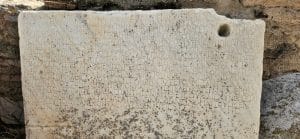
The text recounts the long career of Tiberius Iulius Celsus Polemaeanus, whose tomb is buried in the library. This image shows fragments of the front and side faces of the inscription. The scholarly publication of the text is known as I.Ephesos 5102/ Ephesos 1224.
Greek text
The scientific reading of the inscription is as follows:
Τιβέριον Ἰούλιον Τιβερίου υἱὸν Κορνηλίᾳ Κέλσον Πολεμαιανόν,
ὕπατον, ἀνθύπατον Ἀσίας, χιλίαρχον λεγιῶνος γʹ Κυρηναϊκῆς,
καὶ ἀγορανόμον καταλεγέντα ὑπὸ θεοῦ Οὐεσπασιανοῦ,
στρατηγὸν δήμου Ῥωμαίων,
πρεσβευτὴν θεοῦ Οὐεσπασιανοῦ καὶ θεοῦ Τίτου
ἐπαρχιῶν Καππαδοκίας, Γαλατίας, Πόντου, Πισιδίας,
Παφλαγονίας, Ἀρμενίας,
πρεσβευτὴν θεοῦ Τίτου καὶ Αὐτοκράτορος Σεβαστοῦ
λεγιῶνος δʹ Σκυθικῆς,
ἀνθύπατον Πόντου καὶ Βιθυνίας,
ἔπαρχον αἰραρίου στρατιωτικοῦ,
πρεσβευτὴν Αὐτοκράτορος Καίσαρος Σεβαστοῦ
ἐπαρχίας Κιλικίας,
γενόμενον δὲ καὶ ἐπὶ ἔργων δημοσίων τῶν ἐν Ῥώμῃ,
Τιβέριος Ἰούλιος Ἀκύλας Πολεμαιανὸς ὕπατος
τὸν ἑαυτοῦ πατέρα,
ἀπαρτισάντων τῶν κληρονόμων Ἀκύλα.
Tiberius Iulius Celsus Polemaeanus, son of Tiberius, registered in the tribe of Cornelia;
He served as a consul, became proconsul of the Province of Asia, and held a military tribune in the 3rd Cyrenaica Legion;
He was accepted among the ancient aediles by the deified Emperor Vespasian;
He became the praetor of the Roman people;
He became the imperial representative of the deified Vespasian and the deified Titus in the provinces of Cappadocia, Galatia, Pontus, Pisidia, Paphlagonia and Armenia;
He represented the deified Titus and the emperor with the title of Augustus in the Fourth Scythica Legion;
He became proconsul of Pontus and Bithynia;
He served as the administrator of the military treasury;
He became Emperor Caesar Augustus’s ambassador and governor of the province of Cilicia;
This person also served in the supervision of public buildings and public works in Rome,
The consul Tiberius Iulius Aquila Polemaeanus honored him as his own father.
The work was completed by Aquila’s heirs.
The meaning of the lines in the inscription
1. Τιβέριον Ἰούλιον… Κέλσον Πολεμαιανόν
It means “Tiberius Iulius Celsus Polemaeanus, son of Tiberius”.
Here, the entire inscription is in the nominative case; because at the end of the sentence it is stated that Aquila honored his father with a statue.
2.Κορνηλίᾳ
It states that Celsus was registered in the Cornelia tribune, a Roman citizen tribe. This was a formal record within the Roman citizenship system, rather than a matter of ethnic origin.
3.ὕπατον
Hypatos — consul.
It was one of the highest traditional magistracies in the Roman state. Celsus served as consul in 92 AD.
4. ἀνθύπατον Ἀσίας
“Proconsul of Asia Province”
This was one of the most important roles in Celsus’s career. Ephesus was the center of the province of Asia. Therefore, Celsus’s burial in Ephesus and the construction of a large library in his name is also politically significant.
5. χιλίαρχον λεγιῶνος γʹ Κυρηναϊκῆς
“Military tribune of the 3rd Cyrenaica Legion.”
• χιλίαρχος – chiliarchos: military tribune
• λεγιών γʹ – III. legion
• Κυρηναϊκή – Cyrenaica
This task pertains to Celsus’s military career during his youth.
6.ἀγορανόμον καταλεγέντα ὑπὸ θεοῦ Οὐεσπασιανοῦ
“Choosed among the aediles by the deified Vespasian.”
Here, ἀγορανόμος normally refers to an official responsible for market and bazaar affairs in Greek; however, it is used here in the sense of aedilis, the Greek equivalent of Roman authority.
θεὸς Οὐεσπασιανός is Emperor Vespasian, who had died and been deified at the time the inscription was erected.
7. στρατηγὸν δήμου Ῥωμαίων
“The strategos of the Roman people.”
Here, the Greek στρατηγός corresponds to the Roman office of praetor. So, historically speaking, it’s the correct translation:
“The praetor of the Roman people.”
8.πρεσβευτὴν θεοῦ Οὐεσπασιανοῦ καὶ θεοῦ Τίτου
“The imperial representative of the deified Vespasian and the deified Titus.”
The πρεσβευτής here is not an ordinary ambassador, but rather a high-ranking governor or representative acting on behalf of the emperor, in Latin legatus Augusti.
9. State list
The following regions are listed in the inscription:
- Καππαδοκία – Kapadokya
- Γαλατία – Galatia
- Πόντος – Pontus
- Πισιδία – Pisidia
- Παφλαγονία – Paphlagonia
- Ἀρμενία – Armenia
One of the clearest sections of the inscription is this list of provinces.
This statement indicates that Celsus held a position in the administration of an empire that encompassed a large part of Anatolia.
10.λεγιῶνος δʹ Σκυθικῆς
“IV Scythica Legion.”
Celsus held a high command or imperial representation position associated with this legion on behalf of Emperor Titus and subsequent emperors.
11.ἀνθύπατον Πόντου καὶ Βιθυνίας
“Proconsul of Pontus and Bithynia.”
This document indicates that Celsus served as governor in the Roman province on the southern coast of the Black Sea.
12.ἔπαρχον αἰραρίου στρατιωτικοῦ
“Manager of the military treasury.”
The name of the Latin mode:
praefectus aerarii militaris
It was an important Roman financial office responsible for managing soldiers’ pension payments and military financial resources.
13.πρεσβευτὴν … ἐπαρχίας Κιλικίας
“Representative and governor of the province of Cilicia, appointed by Emperor Caesar Augustus.”
Here, Augustus is not necessarily the personal name of the first emperor, Augustus; it is the official title of the reigning emperor.
14.ἐπὶ ἔργων δημοσίων τῶν ἐν Ῥώμῃ
“He was responsible for public works and public buildings in Rome.”
Celsus was responsible for overseeing public buildings, sacred sites, and public spaces in the city of Rome.
15.Τιβέριος Ἰούλιος Ἀκύλας Πολεμαιανός
This person is Celsus’ son:
Tiberius Iulius Aquila Polemaeanus.
Aquila was also a Roman senator who had become consul, and he initiated the library-monumental tomb project in his father’s name.
16.τὸν ἑαυτοῦ πατέρα
“His own father.”
So the statue was erected by Celsus’ son Aquila in honor of his father.
17.ἀπαρτισάντων τῶν κληρονόμων Ἀκύλα
“Completed by the heirs of Aquila.”
Since Aquila died before the building was completed, his heirs finished the library and monument work.
In conclusion:
“Tiberius Iulius Celsus Polemaeanus, who held the highest office in Rome and was the proconsul of the province of Asia, was honored with this statue. His son Aquila commissioned the statue and monument for his father; after Aquila’s death, the structure was completed by his heirs.”
Therefore, this inscription is not a law or imperial decree, but an honorific inscription listing all of Celsus’s military, political, and financial duties.

Explanation of the titles mentioned in the inscription.
Κορνηλίᾳ — Cornelia
This is Celsus’s Roman citizen tribe. It is not an ethnic name, but rather the Cornelia tribune in the official Roman citizen registration system.
ὕπατος — hypatos
It means consul. It was one of the highest traditional political offices in the Roman state.
ἀνθύπατος Ἀσίας — anthypatos Asias
It means proconsul of the Province of Asia. Celsus held this office around 105–107 AD. This is one of the main reasons why the inscription is dated to 106–107 AD.
χειλίαρχος λεγιῶνος γʹ Κυρηναϊκῆς
It means the military tribune of the 3rd Cyrenaica Legion.
• χειλίαρχος / chiliarchos: military tribune
• λεγιών γʹ: III. Legion
• Κυρηναϊκή: Cyrenaica
This was Celsus’s first military assignment early in his career.
ἀγορανόμον καταλεγέντα
Although the word literally means “chosen among the agoranmos,” here it is the Greek equivalent of the Roman office of aedile.
The correct historical meaning:
“He was accepted among the ancient aediles by the deified Vespasian.”
This explains why Celsus was placed in a specific rank in his senatorial career not through the normal election process, but by the emperor’s decision.
θεὸς Οὐεσπασιανός
“Vespasian the Deified” is the meaning. Roman emperors could be deified by a Senate decree after their death.
στρατηγὸς δήμου Ῥωμαίων
“Stratego of the Roman people.”
However, here στρατηγός is the Greek equivalent of the Latin office of praetor.
“The praetor of the Roman people.”
πρεσβευτής
In standard Greek, it means “ambassador”; however, in this inscription, it corresponds to the Latin title legatus Augusti.
“The Emperor’s authorized representative, governor, or legion commander.”
States;
The inscription lists the following regions as Celsus’s area of responsibility:
• Cappadocia
• Galatia
• Pontus
• Pisidia
• Paphlagonia
• Armenia
These may not represent individual independent governorships; they are a list of provinces and regions belonging to the same broader imperial command.
λεγιῶνος δʹ Σκυθικῆς
It means the IV Scythica Legion.
Celsus served in this legion as a legatus, a high-ranking commander or representative on behalf of the emperor.
ἀνθύπατος Πόντου καὶ Βειθυνίας
It means proconsul of Pontus and Bithynia.
This was one of the state governorships Celsus held during his senatorial career.
ἔπαρχος αἰραρίου στρατιωτικοῦ
Latin mode:
praefectus aerarii militaris
This treasury was primarily concerned with end-of-service payments and retirement bonuses for soldiers.
πρεσβευτὴς … ἐπαρχείας Κιλικίας
“Representative and governor of the province of Cilicia, appointed by Emperor Caesar Augustus.”
Here, Augustus is not necessarily the personal name of the first emperor, Augustus; it is the official title of the reigning Roman emperor.
ἐπὶ ἔργων δημοσίων τῶν ἐν Ῥώμῃ
“He was responsible for public works and public buildings in Rome.”
The parallel Latin inscription describes this task in more detail: the supervision of sacred structures, public buildings, and public spaces belonging to the Roman people.
Τιβέριος Ἰούλιος Ἀκύλας Πολεμαιανός
This person is Tiberius Iulius Aquila Polemaeanus, son of Celsus. Aquila also served as consul and was the one who commissioned:
• the library,
• the mausoleum,
• the equestrian statue,
in the name of his father Celsus.
τὸν ἑαυτοῦ πατέρα
“His own father.”
The verb is not explicitly written in the inscription, but the epigraphic usage means:
“He honored his own father”
or
“He had this statue erected for his own father.”
ἀπαρτισάντων τῶν κληρονόμων Ἀκύλα
“Completed by Aquila’s heirs.” In simpler Turkish:
“After Aquila’s death, his heirs completed the monument.”
In conclusion:
“Tiberius Iulius Celsus Polemaeanus, who served in the Roman army, provincial administration, finance, and the highest state offices, was honored by his son Aquila with an equestrian statue. After Aquila’s death, his heirs completed the monument.”
This stone is not a direct founding document of the library, but rather the inscription on the pedestal of Celsus’s equestrian statue. A Greek version of the inscription was on one side, and a Latin version with almost identical content was on the other side of the stairs.
This important inscription in the Celsus Library in Ephesus silently watches over the travelers of Ephesus, conveying profound and meaningful messages from the past to the present.
Explore Ephesus with Ephesus Tours and our excellent guides.