Blog Titles
ToggleThe Prytanes Law in Ephesus
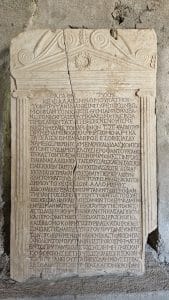
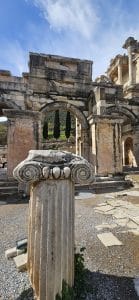
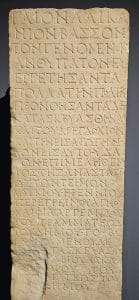
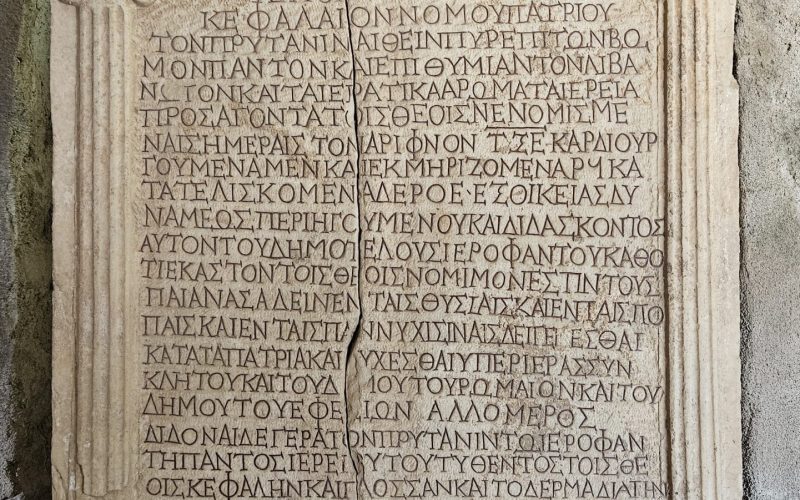
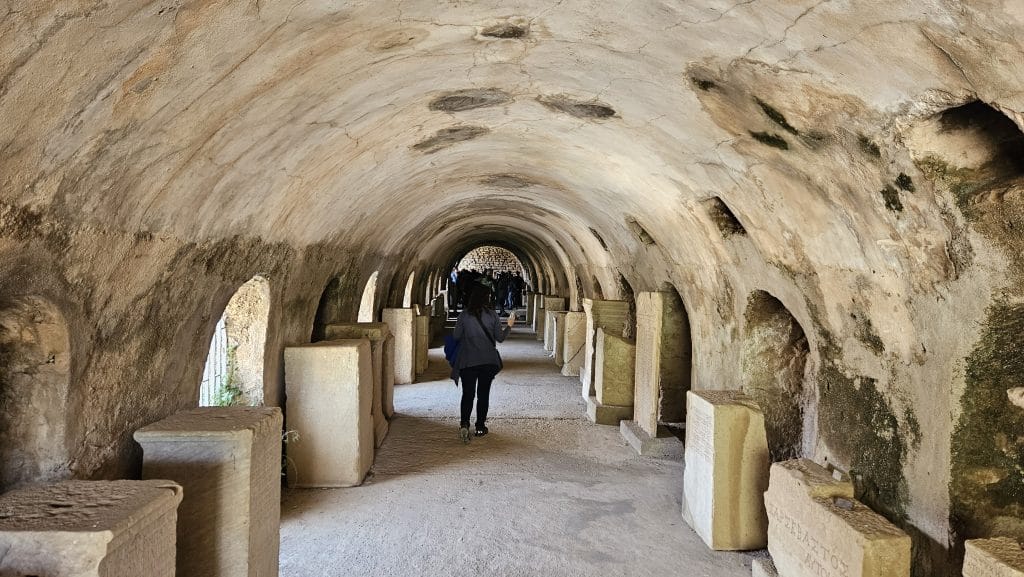
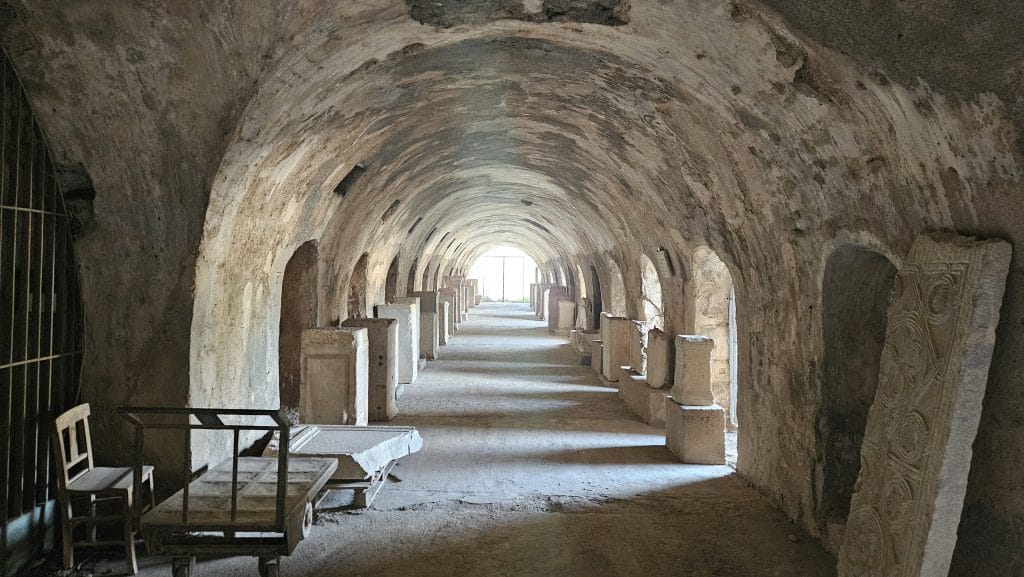
This inscription is located in the Hall of Domitian Inscriptions within the Temple of Domitian in Ephesus, an area inaccessible to everyone. However, it can be entered with special permission.
“With good fortune.”
“The Prytanes Law in Ephesus”
The prytanes must light the fires at all the altars; provide the incense, frankincense, and sacred aromatic substances
according to tradition, which are offered to which gods on which days.
Their number and measure are determined;
their preparation and performance are under the supervision of the demosios hierophantes (public sacred officer/teacher of sacred ceremonies), who is experienced in sacred work and who manages/teaches it.
Furthermore, for each god, in accordance with custom,
paian hymns (deities) must be sung during sacrificial ceremonies, processions,
and night rites. In these, prayers will be offered according to ancestral traditions:
on behalf of the priesthood, the Roman people/senate and the public,
and the people of Ephesus…
It then goes on to mention some honorary shares/privileges to be given to the prytanis and hierophantes. It also explains that the person should be experienced, a messenger of the sacred, and knowledgeable about sacrifices and ceremonies. The following lines also mention the duties related to the Prytaneion, including maintenance/organization and ritual responsibilities.
The content of this inscription:
This is an official regulation text describing how the sacred ceremonies were to be conducted in the Prytaneion in Ephesus.
The content specifically describes:
1 – The lighting of the altar fires,
2 – The offering of incense and sacred fragrances,
3 – The singing of hymns,
4 – Processions and night ceremonies,
the duties of the hierophantes and prytanis.
1) General Characteristics of the Inscription
This text clearly constitutes a cult/ritual regulation, or more precisely, a “summary/main articles of the law.”
The phrase in the upper lines:
Ἀγαθῇ Τύχῃ = “With auspicious fortune / with good fortune”
is a very common opening in public inscriptions during the Hellenistic and Roman periods.
The phrase immediately below:
ΚΕΦΑΛΑΙΟΝ ΝΟΜΟΥ ΠΑΤΡΙΟΥ = “Summary of the ancestral law / main article of the traditional law”
shows that this is not an ordinary votive inscription; it is a normative text explaining a specific public-religious order. Here, νόμος πάτριος (nomos patrios) means “ancestral law / traditional religious order / ancient custom.” So it’s not just a list of duties; it’s the formal expression of the ritual order inherited from ancestors.
The official seen at the center of the text is:
πρύτανις / πρυτάνις or, in this context,τὸν πρύτανιν = Prytanis / prytan
In the Ephesian context, this is a public-religious office, particularly related to the Prytaneion and the conduct of city cults.
The inscription also includes:
ἱεροφάντης = Hierophantes, meaning “official who shows sacred things / conducts and explains sacred ceremonies.”
This is very important; Because we understand that the inscription has not only an administrative but also a ritual-technical character.
2) Meaning Translation of the Legible Main Text of This Inscription
The following translation is not a word-for-word translation; however, it is a contextual and academic translation prepared while preserving the main flow of the text:
The Exactly Predicted Translation
“With auspicious fortune.”
“The summary of the ancestral law:”
The Prytanis must light the fires on all the altars; and also provide all the incense, votive fragrances, and sacred aromatic substances.
These will be offered to the gods on the days deemed appropriate by tradition, in accordance with established custom and sacred rule.
Similarly, the quantity, number, and measure of what is to be offered are determined according to a predetermined procedure; their preparation, distribution, and proper execution within the ritual are necessary.
These tasks will be explained and taught by someone who knows how to do them, who is familiar with the sacred affairs of the house/institution, and who is experienced; that is, the hierophantes, the people’s chosen/public official, will show, teach and supervise the procedure of these tasks.
For each god, proper sacred practices will be performed as commanded by tradition; paians and other sacred hymns will be sung during sacrifices, processions, and nightly ceremonies.
These will be performed,
according to the customary law; and prayers/sacred supplications will be offered,
on behalf of the priesthood,
on behalf of the Roman people,
and
on behalf of the people of Ephesus.
Furthermore, as another matter, the honorary shares/privileges that should be given to the prytanis and hierophantes will be allocated to them.
The person who will undertake these tasks must be experienced in the service of the gods, knowledgeable in performing sacred duties, proficient in sacred messengership (hierokerykia), conducting sacrificial ceremonies, carrying torches/fire, and sacred oversight (hieroskopia).
Furthermore, traditional procedures will be followed in ceremonies related to Kouretis/Kouretes,
in duties connected with Pyrilas/Pyria?, and in other sacred performances.
According to the regulations that have been in effect since the time of the previous officials who served in the Prytaneion,
prytanis, will also be responsible for the arrangement, decoration, maintenance and especially the sacred hearth/sacred space arrangement related to the Hestia of Demeter Karpophoros in the Prytaneion.
3) Main concepts highlighted in the inscription
a) Ἀγαθῇ Τύχῃ
This formula is very common in public and official inscriptions. Its meaning is not simply “good luck”; rather, it is a formal opening formula, such as:
• “with an auspicious beginning,”
• “under the protection of good fortune,”
• “with blessings.”
b) Κεφάλαιον νόμου πατρίου
This expression is very important.
• κεφάλαιον = main article, main point, summary section
• νόμος = law, regulation
• πάτριος = ancestral, inherited, traditional
Therefore, the expression means,
“summary provisions of the sacred law inherited from the ancestors”.
This suggests that the text is probably a short summary of a longer and more detailed religious law or articles of practice inscribed on stone.
c) Prytanis / Prytaneion
In cities like Ephesus, the Prytaneion was not only a political structure but also the center of the city’s identity and shared sanctity.
It typically housed:
• A public hearth (Hestia fire),
• Official reception ceremonies,
• Certain sacred meals,
• Rituals related to the city’s identity.
Therefore, the inscription suggests that the prytanis was not merely an administrative official;
but also one of the practitioners of the public cult.
d) θύμιαμα / ἀρώματα / incense and sacred fragrances
The relevant lines in the text mention elements offered to the gods such as:
• Incense,
• Aromatic resins,
• Sacred fragrances,
• Possibly flammable votive materials.
This shows that the sacrifice was not merely animal slaughter;
it was a complete cult scene involving scent, smoke, torches, chanting, and arranged rituals working together.
e) ἱεροφάντης
The title Hierophantes specifically means an official who “shows/explains sacred things.” In this usage, this person appears to be:
• Someone who knows the ritual procedure,
• Someone who teaches sacred practices,
• Someone who supervises the correct performance,
• Someone who possibly transmits ceremonial formulas and sequences.
Therefore, translating this title simply as “priest” is incomplete. A more accurate translation would be:
“teacher-administrator of sacred ceremonies” or “practitioner and explainer of sacred secrets/procedures.”
f) Paians, processions and night ceremonies
The expressions seen in the inscription suggest that the rituals were performed in several different contexts:
• θυσίαι = Sacrificial ceremonies
• πομπαί = Processions, parades
• νύχες / νύξ context = Night ceremonies or night performances
• παιᾶνες = Paians, hymns
This is a very valuable detail. Because it shows that the city cult in Ephesus was not limited to daytime sacrifices; it included ritual phases with music, processions, perhaps torches, and extending into the night.
g) The Roman people and the demos of Ephesus
One of the most striking aspects of the inscription is that the prayers/sacred rituals were performed not only for the local gods, but also:
• The Roman community/Roman people
• The people of Ephesus (δῆμος τῶν Ἐφεσίων)
in the name of the Roman community/Roman people
This detail suggests that the text likely operated within the context of the Roman Imperial period.
In other words, city religion here is redefined within a harmonious public framework between:
• Local tradition,
• The city institution,
• Roman rule.
In other words:
This inscription shows that Ephesus, while preserving its own “ancestral religion,” also established a public ritual system compatible with the Roman political order.
4) The historical and institutional significance of the inscription.
The value of this inscription is immense; because it shows us, not abstractly but concretely, how the religion of the ancient city operated.
Here we see that:
1. Rituals are entirely regulated. What will be offered on which day, what will be given to which god, these are not spontaneous.
2. There is a list of materials.
Fire, incense, aromatic substances, possibly sacrifices and ceremonial equipment.
3. There is a hierarchy of officials. Prytanis, hierophantes, sacred messengers, overseers and possibly other auxiliary officials.
4. There is music and verbal performance. Paians and sacred hymns are indispensable in the ceremony.
5. City identity is represented through religion. Ceremonies are performed not only for the gods; but also for the continuation of the city, the people and the Roman order.
6. The Prytaneion is both the administrative and sacred center. This building is not just a “municipal building”; it is the ritual heart of the city.