Blog Titles
ToggleChronological History of Ephesus
A detailed chronology of the ancient city of Ephesus.
Ephesus Houses and Their Contents
6700 BC: Life began at Çukuriçi Höyük (the oldest part of Ephesus).
2700 BC: The people of Çukuriçi Höyük moved to Ayasuluk Hill. (Ayasuluk is the name given to the hilly area where Selçuk Castle and St. John’s Basilica are currently located. During the Eastern Roman period, the Basilica of St. John was located here. Christians called it “Hagios Theologos” “Holy Theologian (St. John)” in Greek. This name was gradually Turkified among the people as: Hagios Theologos – Ayasologos – Ayasuluk.
1900 BC: Settlement areas, wall structures, tombs, and pottery dating to the Middle Bronze Age were found on Ayasuluk Hill.
1400 BC: Apasas I, the semi-dependent Arzawa-Mira capital of the Hittites, founded Ephesus.
1400-1300 BC: Mycenaean tombs were built and subsequently discovered on Ayasuluk Hill.
1100 BC: Geometric, Archaic, and Hellenistic tombs were built at the foot of Ayasuluk Hill.
1100 BC: The Attics arrived in Anatolia. Androklos, son of Kodros, founded Ephesus. (2nd Ephesus)
900 BC: Construction has begun on the Temple of Artemis, one of the Seven Wonders of the World.
800 BC: The Cimmerians invaded Ephesus.
Ephesus in the Archaic Period
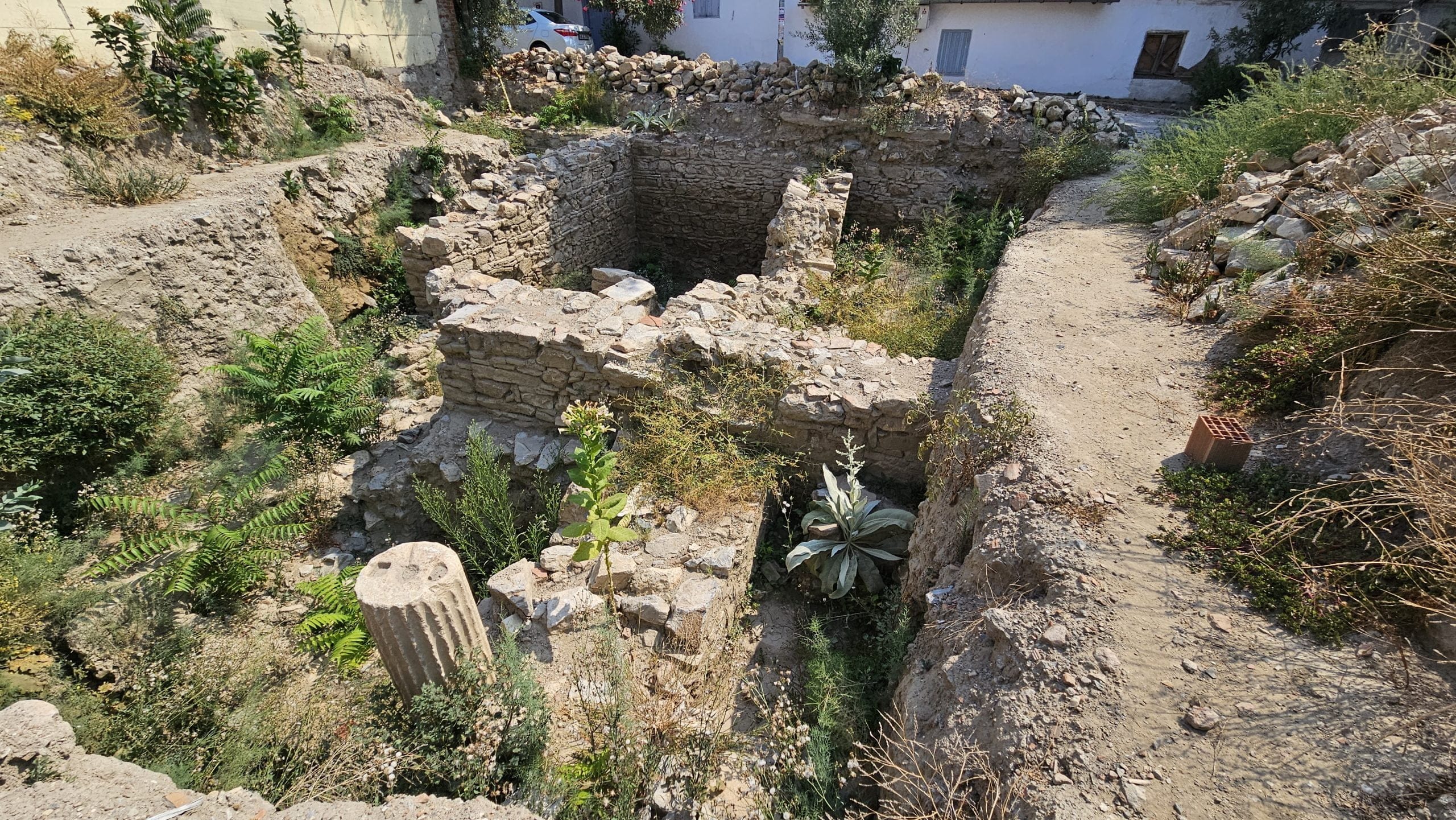
650 BC: Captured by King Gyges of Lydia.
560 BC: King Croesus of Lydia established a powerful presence in Ephesus and provided financial support for the construction of the Temple of Artemis.
560-280 BC: The second city of Ephesus expanded around the Temple of Artemis.
550 BC: Aristarchus of Athens arrived in Ephesus and preached democracy.
547 BC: The Persian commander (Akhshmanid Empire) Harpagos captured Ephesus.
Ephesus in the Classical and Hellenistic Periods
466 BC: Ephesus joined the Attic Maritime League.
356 BC: The Temple of Artemis burned. (It was burned by Herostratus, the shoemaker from Ephesus.)
In 294 BC, Lysimachus, one of Alexander’s commanders, founded the third city of Ephesus. The city’s name became Arsinoe in honor of Lysimachus’ wife.
In 280 BC, Lysimachus began constructing a fortress on the Ayasuluk hill.
In 281 BC, Lysimachus, who founded the third city of Ephesus, was killed in the Battle of Korupedion (near Manisa), a power struggle against Alexander’s other commanders, which Seleucus won. The city of Arsinoe, named after Lysimachus’ wife, was renamed Ephesus.
280 BC – 0 Amphora and sarcophagus tombs at the foot of Ayasuluk Hill.
89 BC – Roman-Pontian Wars (Mithradates VI). Mithradates won.
88 BC – Ephesus Massacre. 80,000 Roman citizens living in Ephesus were massacred by King Mithradates VI of Pontus, who captured the city.
BC 84 BC L. Cornellus Sulla held a trial in which the Ephesians were found guilty.
73 BC L. Licinius Lucullus became the governor of Ephesus.
63 BC – Mithradates VI lost three wars against the Roman Empire. He lost the First Mithradates War to Lucius Cornelius Sulla, the Second Mithradates War to Lucullus, and the Third Mithradates War to Pompey Magnus. Mithradates VI attempted suicide by poison, but failed and committed suicide with a soldier’s sword. The place of his suicide is Panticapaeum, Kerch, Crimea.
41 BC Cleopatra and her lover Marcus Antonius came to Ephesus, and Cleopatra’s sister Arsinoe IV was murdered by Marcus Antonius in the asylon (an asylon is a sanctuary/immunity area in ancient temples) of the Temple of Artemis.
Ephesus in the Roman Period
BC 29. Strabo of Amasia (Türkiye – Black Sea Region), one of the most famous geographers of the ancient world, came to Ephesus.
23-47 AD: Severe earthquakes occurred in Ephesus and its surroundings.
37-42 AD: Saint John and the Virgin Mary came to Ephesus.
44 AD: The death of the Virgin Mary.
48 AD: Saint John, Saint Paul, and other saints went to Jerusalem.
52-55 AD: Saint Paul came to Ephesus and taught at the Trianon school for two years.
In 56 AD, Saint Paul left Ephesus, while Saint Luke remained.
In 65 AD, Saint John became the head of the Church of Ephesus.
In 80 AD, during the reign of Roman Emperor Domitian, he was exiled to the island of Patmos.
In 82 AD, during the Flavian dynasty, Ephesus was given its first title of Neokoros (Temple Guardian). Ephesus received the title of Neokoros five times during the Roman period. (1st Neokoros during the Domitian era – 2nd Neokoros during the Hadrian era – 3rd Neokoros at the Temple of Artemis)
In 95 AD, Timothy became the first chief priest of Ephesus.
In 96 AD, after Emperor Domitian was assassinated, the Temple of Domitian was dedicated to Emperor Vespasian. (Roman Emperor Domitian was “cursed” by the Roman Senate after his death. This practice is called damnatio memoriae (the damnation of memory).)
96 AD: Saint John returned to Ephesus from Patmos.
100 AD: Saint John died in Ephesus.
114 AD: Roman Emperor Trajan visited Ephesus.
124 AD: Roman Emperor Hadrian visited Ephesus.
129 AD: Roman Emperor Hadrian visited Ephesus for the second time.
170-180 AD: Polycrates of Ephesus mentioned the tombs of Saint John and Saint Philip.
250-253 AD: During the reign of Roman Emperor Decius, the Seven Sleepers, mentioned in both the Bible and the Quran, fell asleep.
AD In 262 AD, severe earthquakes occurred in and around Ephesus.
In 268 AD, invading Goths attacked Ephesus and plundered the Temple of Artemis.
Ephesus in the East Roman Period
From 359 to 366 AD, severe earthquakes occurred in and around Ephesus.
From 381 to 384 AD, the Etheria Pilgrimage Group visited the tomb and basilica of St. John.
400 AD: The Temple of Artemis was destroyed.
408–450 AD: The reign of Emperor Theodosius II. Construction of the baptistery in St. John’s Basilica began, and the first construction activities took place in the Cave of the Seven Sleepers.
431 AD: The Third Council was held in the Church of the Virgin Mary in Ephesus.
449 AD: The Second Council (Synod) took place in Ephesus.
451 AD: John the Orthodox became Archbishop of Ephesus under the title “Exarchen”.
467–468 AD: Severe earthquakes occurred in Ephesus and its surroundings.
527 AD: The old wooden Church of St. John in Ephesus was demolished, and construction began again as a large complex.
AD In 530, Emperor Theodosius arrived in Ephesus and visited the church dedicated to Timothy, the first abbot of Ephesus who was martyred.
In 557 AD, Emperor Justinian enlarged the Church of St. John in Ephesus.
In 557 AD, severe earthquakes in Ephesus and its surroundings destroyed the Eastern Gymnasium Church and affected the Church of St. John.
Between 558 and 560 AD, the damaged sections of the Church of St. John in Ephesus were rebuilt.
In 565 AD, the Church of St. John in Ephesus was completely rebuilt and its construction was completed.
In 600 AD, a domed tomb church was built at the Sanctuary of the Seven Sleepers near Ephesus.
Between 610 and 647 AD, Ephesus became the capital of the military region called Thrakesion.
AD 614–615 AD: The Arab Sasanids attacked and plundered Ephesus.
654–655 AD: The Archbishop of Ephesus moved to the area next to the Church of St. John.
654 AD: Arab raids into the Western Aegean took place, and Ephesus was captured.
716–717 AD: The Arab (Umayyad) commander Maslama spent the winter in Ephesus.
1090–1097 AD: Ephesus came under Turkish rule (during the Tanrıvermiş period).
1147 AD: German Emperor Conrad III visited Ephesus.
1204–1261 AD: The Nicaean Empire (Laskaris dynasty) played an active role in Ayasuluk.
1304 AD: Sasa Bey, together with Mehmet, captured Ephesus (Ayasuluk).
1308 AD: Aydınoğlu Mehmet Bey took Ayasuluk from Sasa Bey. The church began to be used as a mosque.
1309 AD: Catalans seized the sacred objects belonging to the Ephesus St. John Church Treasury, which were held hostage in Phocaea.
1330 AD: The famous Arab traveler Into Batuta arrived in Ayasuluk.
AD 1350–1390 Ayasuluk became the capital of the Aydınogulları principality. Construction of the İsa Bey Mosque and the Kale Köşk (Castle Pavilion) began.
1403 AD Timur’s army plundered Ayasuluk, and the Basilica of St. John was destroyed.
1410 AD Börklüce Mustafa, a disciple of Sheikh Bedrettin, was executed in Ayasuluk.
Ephesus in the Turkish Period
1653 AD Severe earthquakes in and around Ephesus destroyed settlements in Ayasuluk.
1653 AD Evliya Çelebi and the Englishman John Covel visited Ayasuluk.
1863–1874 AD English architect John Turtle Wood conducted excavations in Ephesus to find the Temple of Artemis, and he found it.
1895 AD The Austrian Archaeological House began excavation work in Ephesus.